Showing posts with label Consumer Price Index. Show all posts

Thursday, September 13, 2012

Core inflation rises again

After more than two and a half years where the upward pressure on inflation was coming from Energy Products and Mortgage Interest, the past few months have seen the overall inflation rate and the core inflation rate converge (while also increasing).

Core inflation is measured by excluding the impact of energy products and mortgage interest from the overall CPI.  These account for 17% of the overall CPI basket so ‘core’ inflation here is the remaining 83%.   It can be seen below that this measure of inflation is now running at its highest rate since the start of 2009.

Core Inflation August 2012

In August both overall inflation rate was 2.0% per annum with the core rate just above this.  The Energy Products category recorded 10% inflation over the past twelve months while Mortgage Interest in the CPI is now 13% lower than it was this time last year (this followed from Mario Draghi’s almost immediate decisions to reverse the 0.5 percentage points of interest rate increases introduced by Jean Claude Trichet in the summer of 2011).  The weights for energy products (11.4%) and mortgage interest (5.6%) in the CPI basket of goods means that the inflation rate for these combined is equal to 1.8%. 

So what is pushing up the rate of inflation.  Here is table from the CPI Detailed Sub-Indices release with categories that have a CPI weight greater than 0.25% and an annual inflation rate greater than 2.5% (fruit and vegetable juices ‘passed by compensation’ to meet the entry criteria).

CPI Positive

An equivalent table with inflation rates of –2.5% or lower is below the fold.

This time telephone services and other personal effects bounced in off the post (either one) and it can be seen that the total weight of items with in this table of falling prices is one-third less than in the table of rising prices.

CPI Negative

Friday, August 10, 2012

Core Inflation Rises

Yesterday’s Consumer Price Index release for July from the CSO shows the overall rate of inflation falling for the fourth month in a row.  However, the source of inflation in Ireland is slowly beginning to shift.

July marked the since the start of 2010 that the overall inflation rate was equal to the ‘core’ inflation rate.  In this instance the core inflation rate is the 85% of the overall index that excludes energy products and mortgage interest.

Core Inflation July 2012

The overall index is being pulled down by reductions in mortgage interest (particularly for trackers with ECB rate now at 0.75% compared to 1.50% this time last year).  Excluding mortgage interest inflation is still running at 2.3%.  Since March the overall rate of inflation has fallen from 2.2% to 1.6%.  However there has been no significant drop excluding mortgage interest is just from 2.4% in March to 2.3% now.

Annual inflation is now being driven up by the following products (number in brackets is the expenditure weight in the CPI showing the importance of the price change):

  • Tobacco (2.6%) +6.5%
  • Private Rents (4.4%) +2.0%
  • Housing maintenance materials (0.3%) +3.9%
  • Non durable household goods (0.7%) +2.3%
  • Electricity (2.3%) +14.5%
  • Gas (1.2%) +18.1%
  • Health (4.6%) +0.7%
  • Motor fuel (6.1%) +6.3%
  • Motor tax (1.2%) +10.8%
  • Bus and taxi fares (1.0%) +6.4%
  • Air passenger transport (1.6%) +3.0%
  • Newspapers, books and stationery (1.5%) +1.7%
  • Package holidays (0.7%) +3.3%
  • Third-level education (1.6%) +13.5%
  • Licensed premises (6.5%) +1.7%
  • Health insurance (2.9%) +15.3%
  • Motor insurance(1.7%) +1.7%

There are numerous categories that have seen price declines as well and these are in the detailed sub-indices from the CPI.

Thursday, April 12, 2012

Core inflation jumps higher

This morning’s release of the March Consumer Price Index by the CSO shows that the headline rate of inflation edged higher rising from 2.1% in February to 2.2% in March.  A measure of “core” inflation excluding mortgage interest and energy products reveals a different pattern.  The measure of inflation represents about 85% of the overall index.

Core Inflation March 2012

Core inflation jumped from 0.7% in February to 1.3% in March and this is the highest this measure has been since January 2009.   Annual inflation in mortgage interest turned negative for the first time in almost two years in March and the contribution of rising energy prices to the CPI also fell slightly.

Thursday, December 8, 2011

Inflation edges higher

Today’s CPI release from the CSO reports that the headline rate of annual inflation rose from 2.8% in October to 2.9% in November.  As has been the case since inflation returned to positive territory in the middle of 2010 this continues to be mainly driven by just two categories; energy products and mortgage interest. 

The price of energy products are up 13.7% in the year, while the price of mortgage interest is up 17.8% in the year.  These make up 15% of the index and removing them gives a measure of ‘core’ inflation.  Core annual inflation in November was 0.66%, up from 0.55% in October.

Core Inflation November 2011

On mortgage interest, it is important to realise that the CPI measures the price of mortgage interest and not necessarily the cost.  The price of mortgage interest change but the cost to most households may not change if this change is not also applied to existing mortgages.  This has happened in Ireland for the past 18 months or so.  Mortgage variable rates have been increasing far more than tracker rates and these form most of the mortgage interest price in the CPI. 

The mortgage inflation rate in the CPI overstates the average increase in mortgage rates as it reflects mainly the rates that have been rising by more(standard variable rates) and largely omits the rates which rose only slightly (tracker rates).  Almost half of all mortgages are on tracker rates.  This is explained in a Information Note to the CPI release.

In line with normal practice for a fixed base price index, the current approach to measuring mortgage interest in the CPI reflects the situation in the base reference period December 2006 when the standard variable rate was dominant. Subsequently, tracker mortgages have become more popular. This did not give rise to any difficulties while the standard variable and tracker mortgage interest rates moved broadly in line with one another, which would be the normal expectation. However, the decoupling that has taken place since August 2009 has resulted in dramatically different trends emerging. For example, between September 2009 and September 2010 the standard variable rate increased from 2.93% to 3.66% whereas the tracker rate did not change. The Mortgage Interest component of the CPI, which is largely determined by the trend in the standard variable rate, increased by 25.1% as a result and contributed +1.25% to the overall change in the All Items index. It is crudely estimated that the latter impact would have been reduced by between 0.2% and 0.5% had the Mortgage Interest component been calculated on a current weighting basis. Users should take this “weighting effect” into account in interpreting the mortgage interest related movements in the index.

Thursday, November 10, 2011

Core inflation stays low

The headline rate of inflation from today’s Consumer Price Index release is 2.8%.  However 2.33 percentage points of that are accounted for by just two categories: energy products and mortgage interest.  These make up about 15% of the index.   Mortgage interest is up 18.1% on the year and energy products are up 13.4% on the year.

The remaining 85% of the index, which we are using as a measure of ‘core’ inflation, contributes just 0.47 percentage points to the overall inflation rate and is showing annual inflation of 0.55%.

Core Inflation October 2011

The headline rate is inflation is nearly 3% but outside of mortgage interest (and it is only standard variable rates that are picked up in the index) and energy products inflation remains low.

Thursday, October 13, 2011

Core inflation rises slightly

Overall annual inflation from September’s Consumer Price Index shows a jump from 2.2% in August to 2.6% in September.  If we look at the 85% of the index that excludes mortgage interest and energy products the increase was from 0.3% to 0.4%.

Core Inflation September 2011

Although the headline rate of inflation is 2.6%, the majority is provided by two categories that make up 15% of the index.  Both energy products and mortgage interest contributed 1.1 percentage points to overall rate, leaving 0.4 percentage points for the remaining 85% of the index.

Here are the contributions for all categories in the CPI.

Contributions to CPI Inflation

Thursday, August 11, 2011

Reduced VAT and price changes

The July CPI is also the first the picks up the effect of the reduced VAT rate of 9% on the supply of certain goods and services. Details here.  We can use the CPI Detailed Sub-Indices to gauge some of the effect of the VAT reduction. The results are mixed.

VAT Price Changes

The price changes vary from a 4.1% drop in the price of newspapers (the full VAT reduction was passed on) to a 0.9% increase in the price of accommodation services.  Prices for cinema and hairdressing dropped by around 2%, with the cost of eating, canteens and takeaways all falling by less than 1%. 

Although the reduced rate of VAT is supposed to apply to cultural admittance and sports participation the price of both was unchanged in the month, though their prices are down more than 5% on the year.

All told, the categories listed here fell by 0.79% in the month and contributed to a monthly fall of less than 0.1% in the overall CPI.  Outside of newspapers it is hard to find significant evidence of the VAT reduction feeding through to price reductions.

Core inflation edges down

According to the July release of the CSO’s Consumer Price Index the headline rate of inflation stayed at +2.7% for the third month in a row. Prices on the month were unchanged.  Our measure of “core” inflation (the 85% of the index excluding energy products and mortgage interest) slipped down on the month.

Core Inflation July 2011 

Core inflation slipped from +0.5% in June to +0.39% in July.  Of the headline rate of 2.7%, 1.4 percentage points or more than half, is contributed by mortgage interest.  Energy products contributed 0.9 percentage points to the headline rate.

Thursday, July 14, 2011

Core inflation edges down

The June Consumer Price Index shows little change in inflation. The overall inflation rate remained at +2.7%, the level recorded in June, while our measure of core inflation, excluding energy products and mortgage interests, fell slightly to +0.5%.

Core Inflation June 2011

Our conclusion from May remains valid.

The measure of core inflation used here accounts for around 85% of the total index so those who are suffering from rising prices are:

  • those with standard rate mortgages with mortgage interest in the CPI (weighting 6.66%) up 24.1% on the year (we can also expect a further increase in ECB linked tracker mortgages over the coming weeks), and
  • those who purchase a lot of fuel with energy prices in the CPI (weighting 7.77%) up 11.6% on the year.  These are particularly drivers, as petrol and diesel make up about 50% of the energy subgroup and are up 13.8% on the year.  See here.   The other half of the energy sub-group (electricity, gas, liquid and solid fuels) is also rising up 6.8% on the year.

So somebody who has a standard variable rate mortgage and drives a lot is facing significant price increases compared to 12 months ago.  Outside of these particular cases the average inflation rate is quite low with the other 85% of the index rising only 0.5% on the year.

Thursday, June 16, 2011

Irish and UK CPIs

Here is a quick update of a previous post which compared the movements of the Consumer Price Indices for Ireland the UK since January 2007.

Irish and UK CPIs

As would be expected the pattern has not changed much though the Irish CPI has being edging upwards since the start of the year.  Since January 2007 the Irish CPI has risen 4.1%, which is also the same rise since January 2010.  The UK CPI has risen 15.8% since January 2007 and is up 6.3% since January 2010.

Friday, June 10, 2011

Inflation Falls; Consumer Confidence Rises

I am just including these two measures in a single post and am not suggesting a direct causal relationship between them.

The May Consumer Price Index release from the CSO shows that the rate of annual inflation fell from 3.2% in April to 2.7% in May.  However once we strip out mortgage costs and energy prices our measure of core inflation hardly moved with a recorded drop from 0.66% to 0.61%.

Core Inflation May

We can see that excluding mortgage interest, which is being pushed up as banks raise their standard variable rates, and energy prices, which is rose because of excise duties and the externally determined price of oil, that prices across most of the economy are, on average, relatively stable.

The measure of core inflation used here accounts for around 85% of the total index so those who are suffering from rising prices are 

  • those with standard rate mortgages with mortgage interest in the CPI (weighting 6.66%) up 20.1% on the year (we can also expect a further increase in ECB linked tracker mortgages over the coming months.) and
  • those who purchase a lot of fuel with energy prices in the CPI (weighting 7.77%) up 10.5% on the year.  These are particularly drivers, as petrol and diesel make up about 50% of the energy subgroup and are up 14% on the year.  See here.   The other half of the energy sub-group (electricity, gas, liquid and solid fuels) is also rising up 6.6% on the year.

So somebody who has a standard variable rate mortgage and drives a lot is facing significant price increases compared to 12 months ago.  Outside of these particular cases the average inflation rate is quite low with the other 85% of the index rising only 0.6% on the year.

This week also say the release of the May update of the ESRI/KBC Consumer Sentiment Index.  The index rose from 57.9 in April to 59.4 in April.  This seems to be based on future expectations where the sub-index rose by 8.5 points on the month rather than current conditions where the sub-index fell by 8.8 points on the month.

CSI May

At 59.4, the index is now significantly above the local minimum of 44.4 recorded in December 2010 in the aftermath of the EU/IMF intervention and the global minimum of 39.6 in July 2008 with the pace of economic decline was at its most severe.  The consumer sentiment index is showing improvement but it is from very low levels and the overall outlook remains gloomy.

Friday, May 13, 2011

Core inflation continues to rise

The CSO has released the April CPI numbers.  Core inflation, which excludes energy and mortgage interest, moved to +0.66% from +0.23% in March.  The increase in the headline rate moderated in April and the annual inflation rate now stands at +3.3%.

Core Inflation April 11

Thursday, April 7, 2011

Core inflation returns

The CSO have released the March CPI numbers and headline inflation is now running at 3.0%.  Looking at our measure of core inflation, we see that this has moved into positive territory for the first time in almost two years. 

Core Inflation March

Up until now the positive inflation we have had has been driven by energy prices and mortgage interest.  Energy prices are largely determined externally, though the increase in excise duty in last December’s budget are also a factor.   Mortgage interest rates have been driven up as our ailing banks have been pushing up variable and fixed rates for the past 18 months or so.  Here are the inflation rates in these categories for the past three years.

Energy Inflation MarchMortgage Inflation March

Energy inflation is now running at 14.8% with mortgage interest an eye-watering 28.6%.  Both of these are likely to increase in the coming months.

Up to now there was some solace that the positive CPI rate was not determined by the movements of core prices in the Irish economy and were only reflective of substantial changes in particular sectors.  This is now not true and prices are rising (or falling less slowly) across all sectors of the economy. 

We can see this if we compare the current annual inflation rate in the 12 commodity categories provided by the CSO to that from last November.

Inflation Rates

Of course, some sectors still are exhibiting deflation as can see.  The point is that in sectors with inflation prices are now rising faster and in sectors with deflation prices are now falling slower. 

This is not to say that everything is getting more expensive.  It is just indicative of where prices changes are going.  Here are the actual price changes showing that some things are cheaper.

Price Changes

If we compare the price of these commodity groups to last November we can see that for clothing, furnishing, recreation, education and restaurants prices are now lower than they were five months ago.  Over the coming months it is likely that fewer of these comparisons will be negative.

Thursday, March 10, 2011

Core deflation almost gone.

The latest CPI figures from the CSO show overall annual inflation is running at +2.2%.  If we strip out the effect of mortgage interest and energy costs to examine core inflation we see that is running at -0.04% and will likely turn positive next month.

Core Inflation February

Thursday, February 10, 2011

Core Deflation Eases

This morning the CSO have released the January Consumer Price Index.  The overall rate shows annual inflation running at +1.7%.  We have been tracking a core measure of inflation that excludes the effect of energy and mortgage interest prices.  Although, core inflation remains negative, it did ease significantly in January.

Core Inflation January

The rate of core inflation increased from –1.1% in December to –0.5% in January.

The CSO provide prices indices for 13 commodity groups.  Here are the indices that are shown lower prices when compared to three years ago.

Lower Indices

The price changes since January 2008 are:

  • Food and Non-Alcoholic Beverages (-5.15%)
  • Clothing and Footwear (-20.44%)
  • Housing, Water, Electricity, Gas and Other Fuels (-14.36%)
  • Furnishings, Household Equipment and Routine Maintenance (-8.43%)

Two other categories have shown small price drops but are not shown on the graph. These are Recreation and Culture (-1.97%) and Restaurants and Hotels (-0.77%).  Here the commodity groups that show rising prices since January 2008.

Higher Indices

The price changes are:

  • Alcoholic Beverages and Tobacco (+5.47%)
  • Health (+10.47%)
  • Transport (+2.39%)
  • Communications  (+3.66%)
  • Education (+14.04%)

Tuesday, January 25, 2011

Comparing CPIs

Here is just a quick comparison of the overall consumer price indices in Ireland and the UK since the start of 2007.

Irish and UK CPIs

Over the four-year period shown in the graph above the CPI in the UK has risen by 13.2%, with an equivalent rise in Ireland of only 2.0%.  This is substantial difference, and as we can see it is the last two years that has seen this inflation wedge emerge.

In 2007 the Irish CPI rose by 4.8% compared to 2.9% in the UK.  In 2008 the UK CPI rose by 3.8% with the CPI rise in Ireland moderating to 1.6% and by December 2008 the two indices with base of January 2007 were equal.  Over the past two years the CPI in the UK has risen by a further 7.5%, while in Ireland over the same timeframe the CPI has fallen by 2.1%.

It would be interesting to compare the main determinants of the two indices and the graph above does not account for any price differential that may have existed in January 2007.  However, the picture is clear and any price gap that did exist is being reduced.

Thursday, January 20, 2011

Core deflation persists

Although the headline inflation figure shows inflation jumping to 1.3% in December, this does not reveal the full nature of price trends in the Irish economy.  In December alone, the CPI rose by 0.20%.  However, if we just taken energy prices out of the index, this measures shows that prices fell by –0.23% in December.

Energy products make up less than 8% of the overall index and these prices were inflated in December due to the increases in Excise Duty that came into effect on the night of the Budget early in the month. Excluding these somewhat artificial price changes, though they have a real effect, we see that prices fell in the month.

Looking at our comparison between overall and core inflation which excludes the effect of energy products and mortgage interest and reflects 85% of the overall index we see that core deflation remains and is easing very very slowly.

Core Inflation December

If we look at the original index value we can see how the overall and core measures of inflation are beginning to diverge.

Core Inflation Index December

It is clear that after a period of stability up to August 2010 that prices as measured by our core measure of inflation have been continuing to decline.

Thursday, December 9, 2010

Core Deflation continues

The headline figure from the CSO’s November CPI release is that annual inflation is now running at +0.6% and has been positive for that past four months. 
However, ignoring mortgage interest and energy products, the remaining 85% of the index is continuing to exhibit annual deflation.
Core Inflation November
Core deflation did ease slight in November but was still running at –1.33% in November, a slightly decreasee on the –1.42% recorded in October.
Although the annual rate has been positive since August, for the past six months the only month to show a monthly increase was September when prices rose 0.7% in the month.  For the other five months prices were either unchanged or falling.  The annual rate is positive because of monthly increases that occurred between February and May.  This upward pressure on prices has eased.
Monthly Inflation November

Thursday, November 11, 2010

Core deflation stubbornly remains

The CSO have published the October CPI release.  The headline is that annual inflation is up.  In October, the overall rate of inflation increased to +0.7% from +0.5% in September.  But what are the measure of core inflation we have been tracking.

This measure excludes the effect of mortgage interest and energy products and represents 85% of the overall index.   Mortgage interest represents a single product and you can see the components of the energy products sub-group here.

Deflation in this measure is proving much more stubborn.  Core deflation was –1.41% in September and was largely unchanged at –1.42% in October.  Excluding mortgage interest and energy products, consumer prices fell slightly in the month to October.

Core Inflation October

It is probably too much to expect that there will be no commentary relating the CPI figures to inefficiencies in the “state-controlled” sectors but if there is note this.

Friday, October 15, 2010

The CPI and “state-controlled” sectors

We have given a quick look to the September CPI release and concluded that the deflationary pressures in the economy have not disappeared, even if the headline rate of inflation has been positive for the past two month.

A feature of the commentary on the CPI is that it is supposed to give an indication of rising costs and inefficiency in the “state-controlled” sectors of the economy.

For example a piece in The Irish Times includes

Responding to the figures, Fine Gael spokesman on enterprise Richard Bruton said there was no sign consumer confidence had returned, while it was sectors where prices are regulated by the Government that continued to see upward pressure on prices.

The Small Firms Association (SFA) and the Irish Small and Medium Enterprises Association (ISME) criticised the Government for not tackling costs in the business sector and said further jobs would be lost if they are not brought under control.

Similarly from an article in The Irish Examiner:

Director of the Small Firms Association Avine McNally said the September inflation figures show inflation is being driven by increases in public utility costs, such as housing, water, electricity and gas.

And not leaving out this piece from The Irish Independent:

Avine McNally, director of the Small Firms Association, said public utilities were still driving up overall costs.

"Irish small businesses have taken harsh steps to regain cost-competitiveness, but any gains are negated by the costs imposed by the Government-administered sector," she said.

ISME, the Irish Small and Medium Enterprises Association, said state costs are continuing to cripple companies.

Chief executive Mark Fielding said: "It is vitally important that the root causes of the dramatic increases in production costs witnessed over the last number of years, including Government-controlled costs, are brought under control or else we run the risk of continuing to price ourselves out of the market.

And they are lots more piece like that out there.  I gave a brief response to commentary like this when considering last January’s CPI release.  The mistruths have continued.  In the blogosphere Constantin Gurdgiev has a post on “Rip-off Ireland is Rearing it’s Ugly Head”.  Constantin concludes that the numbers in the CPI:

are all signaling that we are living in a public sector boom times, as the Government seemingly pushes forward with the agenda of beefing up semi-states revenues at our expense.

I think there are lots of reason to discredit the public and semi-state sectors, but there is little evidence from the CPI to do this.  I posted a comment to Constantin’s original post but given the further commentary published to today I feel compelled to add a bit more, but most of this comes from my contribution on Constantin’s excellent site.

For the business lobby above I will make one retort.  The CPI is the Consumer Price Index, not the Business Cost Index.  The CPI measures the prices consumer’s pay not the costs incurred by businesses.  There may be some relationship between them but it is not accurate to draw the conclusions suggested above.  The CPI is a weighted index based on the expenditure patterns of households.  It does not reflect the spending or mix of spending of businesses. 

We turn to the conclusions of Constantin Gurdgiev.  He finishes

So good news then is that:

  1. State services, such as Education (+9.5% ! in 12 months);
  2. Banks payback to consumers for propping them up (CPI is up +0.5% yoy and ex-mortgages CPI is down -0.9% over the same period. So far, we have had, courtesy of our banks rescue plans: in a year to September 2009 mortgages costs fell 48%, in a year to September 2010 they rose 25.1%. All despite the fact that Irish banks are no longer facing higher costs of funding - instead they are simply borrowing from ECB using our bonds, for which you, me and our kids will be liable);
  3. State-set charges on energy (+8% yoy);
  4. State set health costs (+0.5%);
  5. Largely state-set or influenced transport costs (+1.4%)
are all signaling that we are living in a public sector boom times, as the Government seemingly pushes forward with the agenda of beefing up semi-states revenues at our expense.
Clearly, we've turned another corner, folks, and it's the 'Ugly Boulevard' ahead of us, consumers.

Here is my reply

The CPI is a measure of prices. For many of the services provided by the state sector a consumer price does not exist, hence the CPI offers no insight into the performance of most state sectors. I have previously addressed similar commentary.

You can see what is in the 'Education' sub-group in the following table.

Table 3.1

Prices for private primary, private secondary, driving lessons and other training are largely outside the impact of the state sector. The huge amount of primary and secondary education services provided by the state make no appearance in the CPI. There is no price to measure.

It is notable, though, that almost half of the Education sub-group is prices in third-level education. The increase in registration fees is driving the 20% inflation in this sub-category (and the 9.5% inflation in the overall education sub-group). This is a state- controlled price. This increase entered into the October 2009 CPI, and with registration fees largely unchanged in 2010 this increase is about to fall out of the CPI.

Some details of the The health sub-group of the CPI can be seen here.
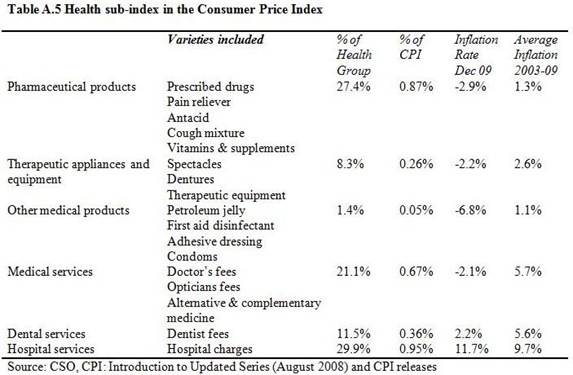
Table A5

Again, it is driven by consumer prices rather than state costs. Obviously the state has a huge role to play in the health sector but one can only infer an indirect effect on the medical goods, drugs and services prices measured by the CPI.

The most recent OECD statistics show health care expenditure makes up nearly 9% of GDP. The health sub-group of the CPI has a weighting of just over 3%.

The Energy sub-category may be up by 8.0% year-on-year, but again these are not "state-controlled costs". 

Energy CPI Sub-Category

Electricity (-1.3%) and Natural Gas (-10.6%) are both down on the year. The increase in this category is almost completely down to inflation in petrol (+11.9%) and diesel (+17.0%). Some of this is down to government (carbon tax) with another portion due to external factors (commodity markets).

Finally, the claim that the 1.4% inflation rate in Transport costs is "state-set or influenced" is again wide of the mark.

Transport CPI Sub-group

Nearly 88% of the Transport sub-group comes from the Purchase of Vehicles and Operation of Personal Transport Equipment. As with the Energy sub-group the positive inflation rate in the Transport group is largely the result of increases in petrol and diesel prices. The only other significant annual increase is in air transport (+16.1%). These prices are largely outside the state sector.

State-controlled rail and bus transport make up only 4.6% of this sub-group (and only 0.6% of the overall index) and both are essentially unchanged on the year.

There is lots of useful information in the CPI but support for "an agenda of beefing up semi-state revenues" is not part of it.

 
Unsecured Loans Proudly Powered by Blogger