Showing posts with label Bank Assets. Show all posts

Thursday, December 29, 2011

Mortgages in Irish Banks (and their interest rates)

A previous post looked at loans in Irish banks.  Here will we confine ourselves to mortgages and will start from this graph in the earlier post.

Household Loans for House Purchase

The Central Bank report Private Household Credit and Deposits Statistics which allow us to look at this in a little more detail.  Here is the same graph (going back to 2003) from the Household Credit series.  The data is quarterly and runs to Q3 2011 so does not include the shifts that occurred in October 2011 that guided the previous post.

Total Loans for House Purchase

In general, the series from the two graphs are similar though the securitised series in the latter graph shows a ‘jump’ in the second quarter of 2009 that is not evident in the first graph.  As there is no corresponding decrease in “on balance sheet” loans it is not clear what was securitised (if anything).

It can be seen that banks in Ireland began securitising mortgages in the middle of 2006 and stopped by the end of 2009 (apart from €17 billion that was “derecognised” in October 2011 of course!)

The benefit of the household statistics is that we can look a little deeper into this although most of the data series only start from the fourth quarter of 2010.  We can, however, get the breakdown of the “on balance sheet” loans for house purchase back to 2003.

On Balance Sheet Loans for House Purchase

Most of the significant step decreases can be explained by increases in securitised loans although the drop that can be seen at the end of 2010 is as a result of Bank of Scotland (Ireland) leaving the Irish market.

The more detailed series are only available for four quarters.  There has been little movement in the series over this period so there is little value in graphing the series.  Here is the most recent data for September 2011 in tabular form. 

First, the total amount of loans for house purchases.

Loans for House Purchase

The €102 billion total of residential mortgages in September 2011 is significantly lower than the €114 billion reported in the Financial Regulator’s Residential Mortgage Arrears Statistics for the same time.  The primary reason for the difference is the absence of Bank Scotland (Ireland)’s mortgage loan book from the above figures.  

We are also provided with a breakdown of the €132 billion of mortgages by interest rate type: standard variable, tracker and fixed for different periods.

Mortgages by Interest Rate

More than half of mortgages in Ireland are tracker-rate loans linked directly to the ECB base rate.  With the ECB rate now back to 1% the repayments on these loans are now much lower than when these loans were taken out in the 2006 to 2008 period.  Finally, we can get a breakdown by interest type for residential, buy-to-let and holiday home mortgages.

Here is a breakdown of the €102 billion of residential mortgages by interest rate type.

Principal Dwelling Loans by Interest Rate

Just over half of residential mortgages on are on tracker rates.  If the €10 billion or so of mortgages in the former Bank of Scotland (Ireland) were included this proportion would be even higher as most of its mortgage book comprised tracker-rate loans. 

The proportion of buy-to-let mortgages that are on tracker rates is even higher.

Buy to Lets by Interest RateAlthough they make up a very minor part of the overall market here is the same data for holiday home and second home mortgages.

Holiday and Second Homes by Interest Rate

Loans in Irish Banks

Here we will give a look at the asset side of the balance sheets of Irish banks, looking specifically at loans and in particular at some large changes that seemed to have occurred in October based on the most recent release of the Central Bank’s Money, Credit and Banking Statistics.

First up, is the total amount of loans on the balance sheets of the domestic banks, broken into the covered group (AIB, BOI, IBRC and PTSB) and the non-covered group (Ulster Bank, National Irish Bank, etc. and also credit unions).

Total Loans in Domestic Banks

There has been a fall in the amount of loans on the balance sheets of the covered banks.  Some of this is due to repayments on existing loans exceeding the amount of new loans issued but most of the drop from a peak of €513 billion in July 2009 can be explained by the transfer of over €70 billion of developer loans to the National Asset Management Agency (NAMA) and the sale of loans to other banks.

The total amount of loans the covered banks had was steady at around €400 billion from May of this year but there was another sharp drop to €377 billion in October.  It would be possible to explain this drop in a chart or two but we will use the drop as a reason to have a fuller look at the loans on the balance sheets of the banks.

Loans in the non-covered domestic group peaked at €165 billion in October 2008 and have fallen by more than half since then, although for 2011 loans in the non-covered domestic group have been relatively steady.  In January they were €79 billion and by October they were also €79 billion.  From January to November 2010 these loans fell steadily from €113 billion to €99 billion.

The large drop in December 2010 (from €99 billion to €79 billion) can be explained by departure of Bank of Scotland (Ireland) from the Irish market.  The loans still exist but they were transferred to Bank of Scotland’s parent group in the UK and no longer appear on the Central Bank of Ireland’s aggregate banking balance sheet statistics. 

From here on we will focus on the €377 billion of loans on the balance sheet of the covered banks.   It is important to note that these are non-consolidated figures, that is they just cover the Irish operations of the banks.  Here is the Irish/non-Irish resident split of the loans.

Loans by Origin in Covered Banks

Loans to Irish residents peaked at €364 billion in June 2009.  Repayments but mainly transfers to NAMA saw this fall under €300 billion May of this year.  Loans to non-Irish residents from the covered banks have fallen from €156 billion in June 2010 to €102 billion now. 

The large drop in October from the first graph can be mainly attributed to the drop from €294 billion to €275 billion in loans to Irish residents, though loans to non-Irish residents also fell (from €108 billion to €102 billion).

Looking at loans to Irish residents (because it is the largest drop but also because we don’t have this breakdown for loans to non-Irish residents) gives a further insight into this drop.

Irish Resident Loans in Covered Banks

Loans on the balance sheets of the covered banks to the private sector (households and businesses) peaked at €256 billion in October 2008.  They then showed a consistent fall over the next three years at stood at €178 billion in September 2011.  From here the big fall in October 2011 can be seen with a drop to €157 billion. 

The exposure of balance sheets of the covered banks to Irish private sector loans has fallen by nearly 40% in the past three years.  The increase in loans to general government are the €30 billion of Promissory Notes given to the IBRC during 2010.

To get a further insight into the changes to private sector loans we have to move away from the balance sheet data and move to the data presented on overall credit in Ireland.  This is credit forwarded by all credit institutions and not just the covered banks but the covered banks make up about two-thirds of the total.  Here are the private sector loans to the household, non-financial corporation, financial intermediary and insurance on the balance sheets of all banks operating in Ireland going back to the start of 2005.

Loans to Private Sector by Sector

It is clear that that the reason for October drop is to be found in the household sector.  The drop in business loans from a peak of €170 billion in August 2008 to €87 billion now is almost fully explained by the transfer of developer loans to NAMA. 

The next step is loans by purpose for the household sector.

Household Loans by Purpose

There seems to have been a huge drop in loans for house purchase (residential and investment) to the household sector over the past few years from a peak of €128 billion in May 2008 to €81 billion in October 2011, with a €17 billion drop in that month alone. 

Of course, Irish households are not repaying debt at that rate and a drop of €17 billion in one month is absurd.  The transaction data provided by the Central Bank show that loans for house purchase to the household sector declined by €319 million in October.  The €17 billion drop is on the balance sheets of the banks not the households (and is down to one of the covered banks as we have seen above). 

So what gives?  The next table from the Central Bank gives outstanding amounts (including securitised loans).  Here are loans for house purchase to the household sector.
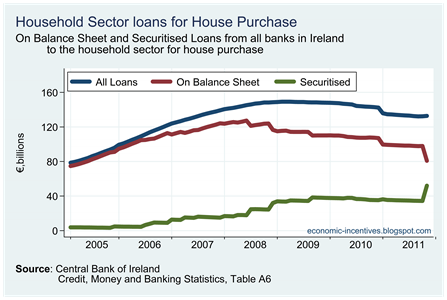
Household Loans for House Purchase

This explains what has happened in October.  Loans for house purchase on the balance sheet of the covered banks fell but only because securitised loans increased by the same amount. 

We can see that the total amount of loans to the household sector from bank operating in Ireland stopped rising in 2008 and has been falling gradually since then.  The stepped drop at the end of 2010 is again explained by the departure of Bank of Scotland (Ireland) from the Irish market.

The Information Note from the Central Bank to the October Money, Credit and Banking Statistics gives mention of this securitisation in a footnote of page 2:

This is due to a credit institution derecognising loans from the statistical balance sheet that had been securitised, in line with the methodology applied by the reporting population in general.

Hmmm.  One the covered banks didn’t realise that it had been reporting €18 billion of securitised loans on its balance sheet that shouldn’t have been there at all.  How very reassuring.  So what did it replace the €18 billion of mortgages on its balance sheet with?  If we go back to the aggregate balance sheet data of the covered banks we can probably infer the answer.
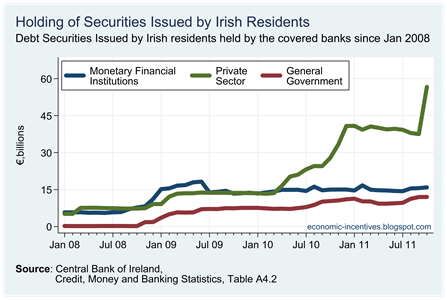
Irish Securities held by Covered Banks

There was an €19 billion rise in the holding of securities issued by the Irish private sector.  This has risen quite significantly recently with most of the rise occurring when the banks received NAMA bonds for their developer loans in 2010.  It was largely steady for the past year until the almost vertiginous rise in October which as we have seen is as a result of “a credit institution derecognising loans from the statistical balance sheet that had been securitised”.  It now seems they had €18 billion of bonds they didn’t know about as well!

The above graph also shows that the banks hold about €16 billion of bonds in Irish banks.  It is not clear how many of these are from the covered banks or in fact if much of it is the banks’ holding of their own bonds.  The rise in the banks’ holding of Irish government bonds can also be seen and stood at €12 billion in October.  This is about 14% of the total stock of Irish government bonds.

I can’t say that there is much to be learned from digging into this non-securitised / securitised shift in October.  It is hard to say who is now carrying the risk of these loans.  It is probably a company linked to the bank as it is unlikely they would have overlooked a transaction with an external third party.

Wednesday, May 4, 2011

Irish Government Bonds

We have looked at the ownership of bank bonds a number of times using the data compiled by the Central Bank.  Over on irisheconomy.ie, Prof. Karl Whelan gives a useful summary of some of the problems that arise when interpreting this data (Who Owns Senior Irish Bank Bonds?).  We examined some of this issues here.

A similar, and now very much related question, is who owns Irish government bonds?  As with the bank bonds this is generally a difficult question to answer.  According to the NTMA there are €89.5 billion of Irish government bonds outstanding.

We can get a partial insight into these from the Central Bank’s Money, Credit and Banking Statistics.   Although much of the focus has been on the liability side of the balance sheets of the covered banks, here we look at the assets.  We have previously looked at this graph here and here.

Irish Securities held by Covered Banks

The green line representing “private sector” bonds is actually mainly those issued to the banks by the National Asset Management Agency (NAMA) in return for the €71 billion of developer loans.  The promissory notes are not in this graph.  They are considered a loan to government.  Details of them can also be found in the “Loans to Irish Residents” graph here.

The blue line for monetary financial institutions is largely the covered banks themselves.  As the posts above point out they didn’t get a huge appetite for bonds in each with the vertical rise in January of this year.  This increase was due to banks holding bonds in themselves.  These “self-held” bonds were issued for three months but it looks like they are being renewed rather than retired.  The remaining €15 billion of bonds from Irish monetary financial institutions remains noteworthy.

Of central interest here is the line showing the holdings of the covered banks of bonds issued by the Irish government.  This is now just over €10 billion.  The covered banks hold about one-eight of Irish government bonds.

Should they hold more?  It might seem unusual to suggest this at a time when a sovereign default is considered “inevitable” by some.  As we saw recently Irish bond yields soared a few weeks ago and the 10-year yield has remained around 10.5%.  A higher yield means a lower price.

Debt total and ratios are usually calculated on the face or nominal value of the debt instrument in issue.  This can be different from the market value.  Although Ireland has nearly €90 billion of bonds outstanding the market value of these is lower.  If the entire market was liquidated it might be possible to buy all this for €80 billion, or maybe €75 billion, or maybe lower.  Is there any convenient way of knowing what the aggregate market value of Irish bonds are?

Anyway, should we not encourage the banks to buy more of these bonds and prices below the nominal value.  In fact, should the country not be doing it?  The NPRF still has around €10 billion in assets that haven’t been used to recapitalise the banks.  The NTMA also has €22 billion of cash in various accounts. 

Why not use some of this money to buy Irish government debt now at reduced prices instead of waiting until maturity and having to repay the full amount?  It would offer a better return than pouring it into the banks!

Tuesday, March 22, 2011

One domestic consequence of default

With talk of “unsustainable debt” and “inevitability of default” growing ever louder I think the following graph from a previous post is important.  While much of the noise has focussed on the liability side of our ailing banks this looks at some of the assets they hold, and in particular assets issued by Irish residents. 

Irish Securities held by Covered Banks

Irish exposure to Irish debt is getting ever larger.  The full implications of a banking- and/or sovereign-debt default need to be examined and this is something that those who are shouting loudest tend to ignore.  Here is the blurb that went with the graph.  This is a point that should not be lost.

The covered banks are holding more and more debt securities issued by Irish residents.  These have increased from €11 billion in January 2008 to €84 billion in January 2011.

Everything is going up.  The increase in “private sector” bonds here are mainly those issued by NAMA in return for the transfer of developer loans from the banks.  Bonds by “monetary financial institutions” are bonds issued by the covered banks themselves.  The almost vertical rise seen in January 2011 is because the banks issued €17 billion of bonds to themselves to use as collateral with the ECB.  As we saw previously, the remainder of this category is €15 billion of bonds the covered banks hold in each other.  Burning these bondholders will just mean more promissory notes will have to be issued.

I cannot really explain the rise in the holdings of “general government” bonds by the covered banks.  It seems unusual that at a time when the State was pumping billion to prop up the banks, these very same banks were using €11 billion to buy bonds issued by the State.  It appears they now hold about one-eighth of Irish government bonds in issue.  Guess who will be hit if there is a sovereign default??

Some insight into the banks’ buying of Irish government bonds is given in this May 2009 article from the Sunday Business Post.

 
Unsecured Loans Proudly Powered by Blogger