Showing posts with label Exports. Show all posts

Thursday, March 10, 2011

The top 10 exporting companies…

… account for 34% of total Irish exports.

That is all.

This stat was presented by the CSO's National Accounts Department at a seminar organised by the Statistics Department in UCC. I will link to the slides when they are available. And note it is the top 10 companies, not the top 10%. Amazing.

Thursday, February 24, 2011

2010 External Trade Figures: Dipped in Chemicals

The CSO have released the preliminary 2010 External Trade figures.  They show a record trade surplus of €44.7 billion.  This is up on the 2009 surplus of €39.2 billion and nearly €20 billion ahead of the pre-crash surplus of €25.7 billion recorded in 2007.  If one was to report a positive economic indicator for the Irish economy, our surging trade surplus would be it.

Annual Trade Balance

The trade balance is significantly ahead of the levels recorded at the end of the export-led Phase One of the Celtic Tiger in 2002.  As the construction- and credit-fuelled Phase Two of the Celtic Tiger took hold from 2003 to 2007 the trade balance fell.  However, since the onset of the current recession the trade balance has gone into a steep incline and this has made a substantial positive contribution to our growth figures (though one that has been swamped by the collapse of some sectors of the domestic economy).

So the prospects of the much-claimed “export-led recovery” must be good, right?  Not quite, I’m afraid.  The trade balance is the difference between exports and imports.  If we look at these we see that the current increase in the trade balance is not due to the same factors that drove the increases during the Celtic Tiger Phase One.

Annual Imports and Exports

The period from 1995 to 2002 was characterised by rising exports and imports, with the faster rate of rising exports increasing the trade balance.   Irish export growth stalled in 2002 (and has not recovered) and in the period 2003 to 2007 the trade balance narrowed as imports rose.  Finally, it is pretty evident that since 2008 the huge increase in the trade balance has very little to do with a stellar export performance (strong, resilient, and robust are popular descriptors).  Instead, the trade balance increased because imports collapsed.

Imports are now back to a level last seen in 1999 and while some might be crowing about our export performance, Irish exports in 2010 were lower than they were in both 2001 and 2002.   While a growing trade balance is good for growth arithmetic, it does not have a significant real effect on the economy if it is based on falling imports.  For an analysis of this see our post on Ireland’s import performance from back in January.  This gives a different insight to the otherwise positive spin that has been put on our trade figures and why this drop in imports is actually bad for the economy.

Here, we will continue with some analysis of the monthly trade figures from the CSO release.

Monthly Imports to December 2010

The drop off in imports since 2007 is self-evident.  The performance of our exports has been relatively stable for the five years shown, though the slight decline that was seen towards the end of 2009 has been reversed and exports in 2010 (€90.0 billion) were very slightly ahead of the those from 2007 (€89.2 billion).  A “export-led recovery” will need a bit more than a 0.9% increase in exports to make any dent on our employment crisis.

Here comes the good news again but this time in monthly figures.  Our monthly trade surplus is now up to around €4 billion a month.

Trade Surplus to December 2010

As per usual it is important to consider the key sectors in our merchandise exports.  Of course, in Ireland’s case it’s actually just one sector.  With only preliminary figures available for December, data by category until November 2010 has been published and this is shown in the following graph.

Exports by Category Proportions

Nearly 60% of Irish merchandise exports are accounted for by one category – Chemicals and Related Products – and this category itself is dominated by one sub-category – Medical and Pharmaceutical Products.  See a previous post for the the impact of the chemical and pharmaceutical sector on the Irish economy using Forfás data.

Here are our pharmaceutical exports since 2005.

Pharmaceutical Exports to November 2010

It would be great if employment in this sector was also close to doubling since 2007 but it is unchanged – the same workers are generating nearly twice as many exports.  In fact, workers in the chemical sector make up about 1% of the workforce and generate nearly 60% of our trade exports.

If we take out the capital intensive chemicals sector from out export figures and see what has happened across the other sectors we do not see the “strong, resilient and robust” performance that is frequently referred to.

Exports excluding Chemicals to November 2010 

In 2007, exports excluding chemicals were €43.6 billion in the first 11 months of the year.  In first 11 months of 2010 the equivalent figure was €33.6 billion – a drop of 21.1%.  Not much sign of strength here.  The “recovery” in 2010 has seen a rise of 0.6% in these exports on the 2009 figures.

Irish export figures are been masked by the dominating effect of the high value chemical and pharmaceutical sector.  If we take this sector our (which is “booming” but has added zero jobs) our export performance is scratchy at best.  If we take this one sector out of the trade balance what do we see?

Trade Balance excluding Chemicals

Yikes.  For the first 11 months of 2010 Ireland had a total trade surplus of €41.2 billion.  Take the impact of chemicals out of that and there was a trade surplus of only €268 million.  The trade balance in the chemicals sector is equivalent to 99.4% of Ireland’s total trade surplus.  Any chance of an extension on those patents??

Thursday, January 27, 2011

The Computer Services Sector in Ireland

After our analysis of the largest merchandise export sector (chemicals at 60% of the total) we will now consider Ireland’s largest services export sector. According to the most recent Balance of Payments data, Computer Services now account for close to 40% of our total service exports.

You can find some analysis of the official CSO data here.  The CSO data is great for the quantities but is lacking information on the impact.  To this end we have turned to the Annual Business Survey of Economic Impact from Forfás, which by value covers about 85% of our total exports (and the missing proportion is largely tourism and travel).

Here’s a run through our Computer Services sector using this data.  And like the Chemicals sector we start with the same conclusion.  Exports have increased (particularly since 2005) but direct expenditure in the Irish economy hasn’t budged.

Computer Services Exports and Direct Expenditure

Since 2003 exports of computer services have grown by 76.8% from €27.9 billion to €47.4 billion.  During this period direct expenditure in the Irish economy has fallen by 13.1% from €11.5 billion to €10.0 billion.

Like the Chemicals sector, Computer Services are dominated by foreign-owned firms which in 2009 accounted for 98.2% of exports in the sector.
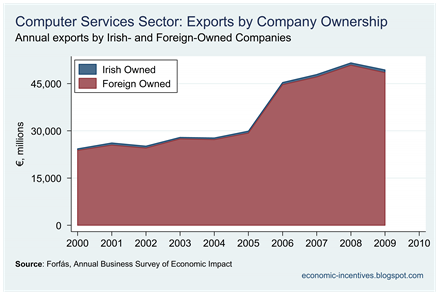
Computer Services Exports by Company Ownership

As expected most of the contribution to the Irish economy comes from the foreign-owned sector, but this is down on the levels seen in 2001-2003 period.
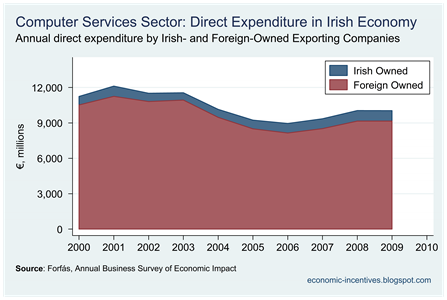
Computer Services Contribution to the Economy

The computer services sector does buy nearly €7 billion of materials a year, but the vast bulk of this comes from abroad.

Computer Services Materials Purchased

Not surprisingly, these companies buy a lot of services, but unlike the Chemicals sector where only 6.4% of services are bought from Irish sources, in the Computer Services sector the purchase of Irish services makes up 41.7% of the total.  In fact, across the companies in the survey purchases of Irish services totalled €13.6 billion in 2009.  At €6.4 billion purchases from the Computer Services sector made up 47.3% of the total.

Computer Services Services Purchased

We can get some information about the purchases of these Irish services by looking at a breakdown of the type of companies buying the services.

Computer Services Services Purchased by Category

Over half of the purchases of Irish services are by Computer Programming companies.  Computer Consultancy companies purchase the bulk of the remainder with the than 5% bought by Facilities Management companies.

Although the purchases of Irish materials and services by these companies has declined from peaks seen nearly a decade, payroll expenses have risen.
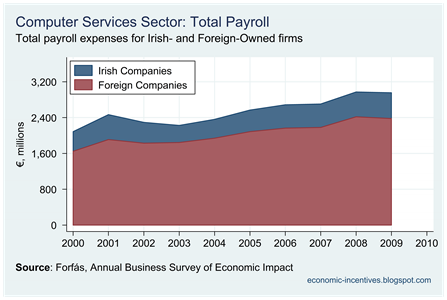
Computer Services Total Payroll

Total payroll expenses rose from €2.1 billion in 2000 to just under €3.0 billion in 2009, with most of this rise coming from foreign-owned companies.  However, this has not been because of an increase in employment.  Again we have the situation of a sector with booming exports offering no employment growth.

[Forfás do not directly provide the employment numbers.  These figures are derived from the Total Sales and Average Sales per Employee figures and are cross checked against Total Payroll and Average Payroll per Employee figures.]
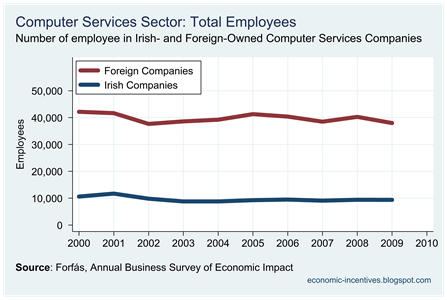
Computer Services Total Employees

Total employment was 52,800 in 2000 and had FALLEN to 49,700 in 2009.  This 5.8% drop in employment took place during the same period when exports rose by 80%.  Thus the increased payroll costs are due to increases in the costs per employee.

Computer Services Payroll per Employee

Average payroll costs in the computer services sector was €62,400 and unlike the Chemicals sector the cost for Irish- and Foreign-owned companies were largely the same.

What isn’t the same is the added value per employee.  There was always a gap between Irish and Foreign-owned firms but beginning in 2005, this gap has ballooned.  In 2009, foreign-owned firms had an average added value per employee of €745,000, dwarfing €104,000 added value per employee in Irish-owned firms

Computer Services Value Added per Employee

Here is a breakdown of added value by company type.  Can you spot the series break??

Added value per employee by Category

Those Computer Facilities Management workers sure are productive!!  Looking at a breakdown of exports by the type of company.

Computer Services Exports by Category

We see that, while all categories are growing, most of the growth in computer services exports is attributable to Computer Facilities Management (again with a huge jump after 2005).  This sector must be contributing hugely to the economy.  Let’s see.

Computer Services Direct Expenditure by Category

Where’s the jump? Initially I thought that this graph was wrong but unless the original Forfás data is right then this is what has happened.  The the Computer Facilities Management sector exports have increased from €1.8 billion in 2000 to €16.2 billion in 2009.  This is an increase of nearly 800%.

At the same time the direct expenditure by companies in this sector (i.e. their contribution to the economy) has gone from €733 million to €810 million, a rise of 10%.  Maybe it’s worth putting these two lines on the same graph.

Computer Facilities Management Exports and Direct Expenditure

And  what about employment in this sector that is clearly driving our “export-led growth”?

Computer Services Total Employees

A sector that has seen exports rise by nearly €12 billion since 2005 (our total exports were €145 billion in 2009) has seen employment FALL from 11,000 in 2005 to 7,600 in 2009.

Sometimes I’m sorry I ask myself these questions.

Wednesday, January 26, 2011

The Chemical and Pharmaceutical Sector in Ireland

The CSO released the November External Trade statistics earlier today and we will consider them in due course.  The dominant category of our merchandise exports is the Chemicals and Related Products category which now accounts for nearly 60% of goods exports from Ireland.  We will use the Annual Business Survey of Economic Impact from Forfás to examine the size and contribution of the Chemicals Sector to the Irish Economy.

First up is the key graph – exports in the chemical sector and the level of direct expenditure (payroll, goods and services purchases) in the Irish economy.  Mind the gap!

Chemicals Exports and Direct Expenditure

In the ten years from 2000 to 2009 chemical exports, in the Forfás sample, increased from €18.2 billion to €37.7 billion, an increase of 107%.  Over the same period the direct contribution from this sector to the Irish economy from €2.1 billion to €3.1 billion, an increase of 48%.  As a percent of exports of the direct expenditure from this sector in the Irish economy is just 8.2%.  Exports can soar in this sector (and they have) but there will be little impact felt on the ground of this “export-led growth”.

Now we will work through the sector in a little more detail.  First up total sales.  There is an Irish Chemicals sector there I promise. Look closely.  Sales in 2009 from Irish-owned companies at €412 million make up just over 1% of the €39.7 billion total sales in the sector.

Chemicals Sales by Company Ownership

In fact, looking at sales is a little redundant as exports make up 96% of sales, though this figure is 57% for Irish owned companies.  The only a negligible difference between the total sales graph above and the total exports graphs below.

Chemicals Exports by Company Ownership

Although Irish firms only make up 1% of sales they do manage to contribute 7% of the direct expenditure in the Irish economy from this sector (€235 million versus €3,113 million).

Chemicals Contribution to the Economy

Of course, there is no way Chemicals companies in Ireland can generate nearly €40 billion of sales from just €3.1 billion of inputs.  They do spend much more than than but the vast majority of it comes from abroad.  First, let’s look at materials.

Chemicals Materials Purchased

Only 6.4% of the €7.6 billion of materials purchased in 2009 came from Irish suppliers.  The pattern of services purchases is not much different.

Chemicals Services Purchased

It may seem strange in a manufacturing industry that over 50% more is spend on service inputs than materials inputs but that is to forget that the most expensive input into the production of a pharmaceutical product is the cost of the patent.  Import expenditure on patent royalties has been soaring in recent years.

These companies have been using more materials and more services in the period that has seen exports rise by more than 100%.  But have they employed more workers? Erm, no.

Chemicals Total Employees

In the period of this huge increase in exports total employment in the sector has fallen by 1,100 from 24,500 to 23,400, with most of this drop occurring in foreign owned companies.  Although Irish companies generate only 1% of sales they do provide just over 10% of the employment (2,400 versus 21,000).

The numbers might be falling but total payroll has been rising and in 2009 was up almost 60% on the 200 level – up from €1 billion to €1.6 billion.

Chemicals Total Payroll

Falling employment numbers and rising payroll costs must mean that payroll costs per employee are rising and indeed they are, particularly in the foreign-owned sector.  According to the Forfás data, the average payroll cost across all exporting manufacturing sectors was €49,800 in 2009.  The sector that ranked highest was the chemicals sector with an average payroll cost of €68,300.

Chemicals Payroll per Employee

But don’t feeling sorry for these chemical companies.  In the foreign-owned sector where average payroll costs are €71,200 the value added per employee (as defined by Forfás) is a staggering €934,700.  Now that’s productivity.

Chemicals Value Added per Employee

All that aside, the key issue remains.  Our export figures may provide the arithmetic for growth but it is likely that an “export-led growth” strategy will make little inroads into our unemployment crisis given that, over the last ten years, our most important trade export category has seen exports rise by over 100% and employment has fallen!

The Chemicals and Pharmaceutical category accounts for nearly 60% of our exports and these are generated by just 1% of the workforce.

Monday, January 17, 2011

The Benefits of Exports

There has been a lot made recently that “export-led growth” is the path out of our current economic morass.  There is no doubt that Irish exports are large and increased up until 2008 and have rebounded again in 2010.  But what have we gained from this increase in exports? The answer: not a lot.

Here is a graph using Forfás data released last November.  The dataset covers about 85% of Irish exports.

Exports and Direct Expenditure

Since 2000 exports from risen by over 50% yet the direct expenditure from the companies that generate these exports has FALLEN, albeit by just over 1% (and this is nominal data).  Exports have risen (and have contributed positively to GDP) but the impact ‘on the ground’ has been less than stellar. 

Direct expenditure as defined by Forfás is made up of two elements

  • Payroll costs
  • Goods and services purchased from Irish sources

The Forfás data show that employment in the sectors that have generated this 50% increase in exports over the ten year period in the graph above has fallen from 310,000 to 250,000. We might have a closer look at this dataset in subsequent posts but the above is a useful starting point when examining the merits of an “export-led growth” strategy.  A breakdown by indigenously- and foreign-owned firms will form the basis for a subsequent post.

Saturday, January 15, 2011

Chemicals, Pharmaceuticals and an Export-Led Recovery

We have seen numerous times that the Chemical and Related Products sector dominates Irish merchandise exports.  The 2010 figures to September that exports from this category make up 59% of total goods exports and have been trending upwards, if erratically, for the past few years as shown below.

Chemical Exports to September 2010

This is been particularly true for the pharmaceutical sub-category of this group where exports are up 63.3% since 2007.

Pharmaceutical Exports to September 2010 

We might have an “export-led strategy”, but what we really need to see is if this increase in exports is being transformed into increases in employment.  Getting such employment data is hard but we can use the information on the “Modern Sector” from the CSO’s Industrial Production releases to get some insight (see table 3 on page 4).

It’s not a perfect fit, and the data does not go back very far, but we can get some insight into employment patterns in this booming export sector.

Chemical Sector Employment

The sector that accounts of nearly 60% of our exports and has shown large increases over the past few years has seen employment rise by 2,300 since the start of 2008 (from 39,900 to 42,200).  These 42,200 employees generate most of our exports 60% of our exports comprise just 2.3% of the 1,851,500 people employed in Ireland. 

Even if doubling exports in this category led to a doubling employment (and it won’t) it would only put a small dent in our unemployment crisis with 299,000 people now out of work.

Monday, January 10, 2011

Prospects for an “Export-Led Recovery”

Here are the slides I used in a seminar today to the Faculty of Commerce in UCC on the prospects of an export-led recovery in Ireland.

Slideshare seems to have thrown a few of the graphs out of whack and the vertical axis labels are missing on all the graphs.  Bar the area plots most of fine with the line charts largely unaffected.

Anyway the presentation had 30 slides to keep me going for the hour and has some interesting bits and pieces on Irish exports and imports of goods and services, but the crux of the matter can be gleaned from just four.

1. Net exports are surging ahead.

Balance of Trade

2. Our trade surplus is generated by our merchandise exports.

Balance of Goods and Services

3.  Until recently this was because imports were falling rather than exports rising.

Exports and Imports to November 2010

4.  Take away Chemicals and the balance you’re left with is …

Trade Balance excluding Chemicals

Monday, December 27, 2010

External Trade: Export Improvement Continues

Just before Christmas the CSO published the September External Trade Release which provides full details of our merchandise trade to September with some preliminary details to October.  Here are our total merchandise exports and imports to October. 

Exports and Imports to November 2010

Although both exports and imports fell in the month to October, the  figures do little to belie the perception that Irish goods exports have shown remarkable resilience during the current crisis with imports falling significantly.  In October, in seasonally adjusted terms, exports fell 1.9% and imports fell by 11.2%.

This resulted in a further widening of the trade surplus.

Trade Surplus to November 2010

The seasonally adjusted trade balance for October was a record €4.153 billion.  It should be noted that this increase in the trade balance is a result of the drop in imports rather than an increase in exports.

On the export side the importance of medical and pharmaceutical products remains.  We now have the breakdown of exports by category to September.  Here are medical and pharmaceutical products exports.

Pharmaceutical Exports to September 2010

Exports in this category have increased to an average around €2 billion a month in 2010, up around 66% from the average of €1.2 billion a month seen in 2007.  Medical and pharmaceutical products now make up around one-quarter of total Irish merchandise exports.

Proportion of Exports from Pharmaceuticals

In fact, total exports in NACE Category 5 chemicals are now around €4.5 billion a month and make up nearly 60% of total goods exports from Ireland.  Graphs of the amount and proportion of exports from this category are behind the links.  Here we see the proportion of exports from all ten main NACE categories.  Click graph to enlarge.

Exports by Category Proportions

The dominance of ‘Chemicals and Related Products’ is visibly clear and outside of ‘Food and Live Animals’, ‘Miscellaneous Manufactured Goods’ and ‘Machinery and Transport Equipment’ the remaining categories are largely insignificant.

Next we consider the performance our merchandise exports excluding the high value chemicals sector.

Exports excluding Chemicals to September 2010

Outside of Chemicals, Irish exports dropped markedly during 2007, 2008 and 2009.  The performance of Irish exports in the recession has been masked by the strong performance in the Chemicals category, and in particular in the Medicine and Pharmaceuticals sub-category. 

It must be noted that there has been something of a turnaround in 2010 and in September these exports recorded their highest monthly level since October 2008.   In fact, if we consider the Balance of Trade for all goods except NACE Category 5 Chemical and Related Products we see that the rest of the economy is moving to surplus after a persistent deficit.

Trade Balance excluding Chemicals

Here are the trade balances broken down by the main NACE categories.

Trade Balance by Category

Excluding Chemicals there is only a trade surplus of €127 million.  However this is a turnaround from the deficit of €1.4 billion recorded to the same time last year.  As with the improvement in the overall trade balance the increase in the trade balance excluding chemicals is down to a fall in imports but for 2010 there also has been a general increase in exports.  The following table shows how all export categories have been performing this year.  It is a good news table!

Exports by Category to September

In the first nine months of the year exports are ahead of 2009 levels in all categories except Machinery and Transport Equipment.  For the same period exports are now only 0.5% behind the peak recorded in 2007, though this is mainly due to the 20% increase in the Chemicals and Related Products category in that time.  Most of the other main categories are showing double-digit declines on their 2007 levels.  See table here.

Although several categories are down on their 2007 levels the main drag on Irish exports over the past four years has been the ‘Machinery and Transport Equipment’ category.  Exports in this category have fallen by almost 50%, and are almost €1 billion a month lower than they were at the start of 2007.

Machinery and Transport Equip Exports to September 2010

Although there are several sub-categories in this group most of the decline can be attributed to the collapse in the exports in the ‘Office Machines and Automatic Data Processing Machines’ (i.e. computers) sub-category.  Exports in this category have fallen by almost 65%.

Computer Exports to September 2010

 
Unsecured Loans Proudly Powered by Blogger