Showing posts with label Department of Finance. Show all posts

Tuesday, December 13, 2011

Do we want miss the budgetary targets?

The measures put together for last week’s budget(s) has the stated aim of getting the General Government Deficit down to 8.6% of GDP.  Although we know neither the final deficit nor the nominal GDP figure it is currently forecast that the deficit will be around 10.1% of GDP this year. 

The original Four-Year Plan published last November targeted a 2012 deficit of 7.0% of GDP but this was based on very optimistic assumptions which had the deficit falling to below 3% of GDP by 2014.  When the EU/IMF deal was brokered a few weeks later the timeframe for getting the deficit under 3% was pushed out to 2015 and at the ECOFIN meeting of 7 December 2010 a deficit limit of 8.6% of GDP for 2012 was set.

The 2011 Budget was announced the same day and still forecast a deficit for 2012 of 7.3% of GDP.  It wasn’t until the Stability Programme Update in April of this year that the 8.6% deficit figure for 2012 made an appearance in Irish documents.

Much has been made of the fact that at 10.1% of GDP the deficit for this year has come in “below target”.  This was not so much below target as below the 10.6% limit set by the ECOFIN meeting last December.  The target from last year’s budget was that this year’s deficit would be 9.4% of GDP.  The deficit is very much larger than the target.

This year the deficit limit was 10.6% of GDP, the target was 9.4% of GDP and the outcome will likely be somewhere in the middle.  Next year the limit is 8.6% of GDP and the target is also 8.6% of GDP.  While there was room for significant slippage this year (and the GGD is almost €800 million larger than forecast in last year’s Budget) there is absolutely no room for slippage next year.

If growth is slightly lower than expected or the measures introduced don’t have the anticipated impact than it is very likely that the deficit will come in above 8.6% of GDP.  This year we had the capacity to absorb such downward developments; next year we have none.

The reduction in the EU interest rates agreed last July will make reaching the 8.6% target a little easier.  These are estimated to save around €900 million in 2012.  If these were applied statically to the projections from the April SPU then the deficit target for 2012 would be around 8.0% of GDP.  This would have been a better target for 2012 but slippages elsewhere have fully absorbed the interest rate gains. Even with €900 million of savings announced in July the deficit target for 2012 is still at the 8.6% of GDP it was last April.

As a result of the interest rate savings we might be able to get fairly close to the 8.6% of GDP limit set by the EC.  How we will fare on the IMF targets are less clear.  The IMF does not make targets based on the overall general government balance and does not make them very far in advance.

The IMF budgetary targets are in terms of the primary exchequer deficit.  This is the deficit on the Exchequer Account excluding interest payments.  The IMF’s Third Quarterly Review (table 2, page 54) sets an indicative target for the end-June 2012 primary exchequer balance of €7.4 billion.  Up the the end of June 2011 the primary exchequer balance was €8.4 billion (exchequer deficit of €10.8 billion less €2.4 billion of exchequer interest payments).

The IMF targets are not affected by the interest rate reductions announced last July.  The primary exchequer deficit has to improve by €1 billion in June 2012 relative to its performance 12 months previously.

In last December’s budget tax revenue was forecast to be €34.9 billion for 2011.  It is now clear that tax revenue of around €34.2 billion will be achieved. And this was only possible with the addition of €0.5 billion from the private sector pension levy announced in the May Jobs Initiative.  On a ‘like-for-like’ basis, tax revenue for 2011 is around €1.2 billion behind last December’s target.

Just like the EC limit there was significant room for slippage when it came to the IMF target.  Last June when the primary exchequer balance was €8.4 billion, the limit set by the IMF was €10.1 billion.  We were well within the limit and had enough room to absorb the deterioration seen in tax revenues in the final quarter.  Once again we have decided to eliminate this capacity and made the limit our target.  The margin for error on the downside is zero.

Some of the numbers in last week’s budget do not stack up.  The Minister for Finance admitted that the 2% VAT increase would not bring in €670 million over a full year because the estimate did not account for a fall in demand.  The is an extra €160 million forecast to be brought in as a result of changes to CGT and CAT.  This is equally unlikely.  The €200 million gain from increases in Excise Duty also seems optimistic.  These make up the bulk of the €1,000 million of new tax measures announced last week.  

Many of the expenditure measures are equally woolly.  Here is a list of “savings” included in the €1,400 million of current expenditure cuts from the Summary of Budget Measures.

  • Enhance fraud and control activity.
  • Continued focus on delivering reductions in the price and volume of goods and services procured by the health services.
  • Savings from anticipated lower disease incidence and operational changes.
  • Miscellaneous Savings on the Vote
  • Achieve a reduction in non-pay administration costs through increased efficiencies.
  • Reduce costs associated with operation of the Mahon Tribunal.
  • Efficiencies and changes to business processes.
  • Streamlining the State’s employment rights bodies.
  • Rigorously review of every area of expenditure.
  • Introduce new efficiencies mainly through the use of IT.
  • Programme savings through efficiencies.
  • A range of measures to improve programme efficiency are being considered.
  • Introduction of efficiencies.
  • Efficiency measures in Revenue, Office of Public Works and savings in legal fees in Law Offices.
  • General savings in Departments of Arts, Heritage & the Gaeltacht and Communications, Energy & Natural Resources.

The arithmetic might add up to a budget with €3.8 billion of “adjustments” but the reality is likely to be somewhat different.

After a year of being “the best in the bailout class” are we actually looking to exceed the deficit limits set down by our external funding partners?  Is there political capital to be gained from missing these targets?

Monday, December 5, 2011

Social welfare expenditure to fall by €88 million

Today seems like an appropriate time to update this.  The 2012 expenditure of the Department of Social Protection was subjected to €475 million of “savings measures” today.  It is projected that the full effect of the measures announced today but which will come into effect over the next three years will be €811 million.

In 2011 it is estimated that expenditure on social welfare payments from either the Department of Social Protection or the Social Insurance Fund will be €20,030 million.  With the measures announced today the forecast for 2012 is €19,942 million – a fall of €88 million. 

Here are the expenditures by six main headings for 2011 and 2012.

Social Welfare Expenditure

The actual payments under each heading were detailed in the previous post on this issue.  It can be seen that most of the expenditure increases are for pensions and in particular the contributory pensions paid from the Social Insurance Fund.

Around €45 million of the 2012 savings announced today are as a result of reduction in Child Benefit for third and subsequent children.  Even with this the aggregate amount of Child Benefit is forecast to increase (albeit by just €8 million) from €2,067 million to €2,075 million.

The large drop is income support payments from the Social Insurance Fund is evenly split between a fall in Jobseeker’s Benefit and Redundancy and Insolvency Payments.  The fall in Jobseeker’s Benefit is because entitlements expire after 12 months. Recipients can switch to the means tested Jobseeker’s Allowance paid by the Department of Social Protection where expenditure is forecast to increase by more than €150 million.

In 2009, the outturn for social welfare payments was €19,959 million.  As shown above it is forecast to be €19,942 million in 2012.  This is a drop of 0.08%.  Next year, social welfare payments will be 99.92% of what they were in 2009. 

It is clear there have been significant adjustments to social welfare expenditure and these cuts continued today.  However, there has been no reduction in overall expenditure.  Rather, the same amount of money is being spent but it is going to more people (more children, more pensioners, more unemployed) so, on average, people are getting less.

Thursday, November 24, 2011

How much austerity have we had?

Here is an exchange from last week’s meeting of the Joint Committee on Finance, Public Expenditure and Reform Debate which was attended by members of the Independent Fiscal Advisory Council.

Deputy Mary Lou McDonald: Far from viewing Professor McHale as cautious or conservative, my reaction to his contention that the austerity should be greater and quicker is that it is reckless. I would like him to give us the rationale for his commitment to austerity. Where is the evidence it is working? We have not seen a dramatic reduction in the underlying deficit despite €20 billion having been sucked out of the economy.

Professor John McHale: Deputy McDonald asked if the austerity is working. By that I understand her to mean if it is succeeding in bringing down the deficit. The question is sometimes asked whether attempts at deficit reduction is self-defeating in that the deficit does not come down. In my view it is working. Our assessment of the numbers is that it is working. The overall general government deficit fell from 11.7% of GDP in 2009, and the most recent projection is that it will be 10.3% of GDP for this year, so that is a reduction. The Exchequer deficit for the first ten months-----

Deputy Mary Lou McDonald: Is that a satisfactory rate of decrease?

Professor John McHale: That is a good question. It looks like the Exchequer deficit for the first ten months of this year will be €1.8 billion lower than it was for the first ten months of last year.

In making an assessment, we have to recognise that austerity is not the only factor slowing down the economy. There are significant forces pushing the Irish economy down and this refers to the earlier discussion of the balance sheet recession. There are significant issues of confidence and issues of credit access. This economy has been hit with a number of very severe shocks that have been slowing growth and particularly slowing the growth of domestic demand, which is critical to the fiscal position.

The Deputy is correct that these numbers as regards improvement in the deficit are not startling in the sense that the deficit is on this incredibly slow downward path but the fact that this has been achieved in the face of such headwinds shows that it is actually working. It is hopefully a question of when we get back to growth and the measures taken, such as the new tax and expenditure structures, will yield much more. When we get back to growth and, particularly and crucially, growth in domestic demand which is affected by much more than just the austerity measures themselves, the expectation and the hope is that the deficit will improve more rapidly.

Using our fiscal feedback model, we have also conducted simulations of what would have happened if there had been no adjustment at all. The Deputy referred to the €21 billion adjustment which has taken place so far. On conservative assumptions, the deficit in 2011 would have been 20% of GDP instead of the projected 10.3% if there had been no measures taken. We would be heading for a debt to GDP ratio in 2014 to 2015 of approximately 180% of GDP. We would be fast becoming like Greece. We would probably never get there because we would probably have ended up in default before then.

The question here is not so much on whether austerity is working but on what exactly entails the “€21 billion adjustment” which is referred to in the exchange. The McCarthy Report on State Assets provides a useful summary of the measures that have been introduced up to this year.

Budgetary Adjustments

The sum of measure introduced is indeed €21 billion, but has €21 billion been “sucked out of the economy” over the last three years?  The €21 billion was the projected full-year impact of the measures introduced.  Maybe we should look at what actually happened to see how close reality is to this €21 billion.  I think the answer is closer to €10 billion than it is to €20 billion.

To start we will look at what was introduced each time.  First up is the €1 billion of measures introduced in July 2008.  Here is the list from the Minister’s statement.

  • All Departments, State Agencies and Local Authorities – other than Health and Education - will be required to reduce their payroll bill by 3% by the end of 2009 through all appropriate measures identified by local management in the light of local circumstances. The parameters of this exception for the health and education sector are to be agreed by the Departments concerned with the Department of Finance.
  • All expenditure by Departments and Agencies on Consultancies, Advertising and Public Relations will be significantly reduced for the remainder of this year and by at least 50% in 2009.
  • Further savings in 2008 and in 2009 are to be secured by a range of measures including those identified as a result of the Budget day efficiency review initiated by my predecessor.
  • All of the above efficiencies will apply equally to State Agencies. In addition, I have asked that these agencies be reviewed to examine whether they can share services, whether it would be appropriate to absorb some of their functions back into their parent Departments or whether some agencies should be amalgamated or abolished. The outcome of this will be considered by the Government in the Autumn.
  • The Government has also decided, in the light of the current Exchequer position, that further expenditure for the acquisition of accommodation for decentralisation will await detailed consideration of reports from the Decentralisation Implementation Group.
  • Minister of State Martin Mansergh will head up a joint public procurement operation between OPW and the Department of Finance to drive a programme of reform and to produce a business plan for purchasing savings to be achieved by Departments and other public bodies in 2009. Minister Mansergh will report to me in the Autumn with specific proposals to target at least €50m savings in 2009 on this front.
  • Given the projected revision to GNP and other factors, there will be savings in Overseas Development Assistance of some €45 million this year. The revised total contribution in 2008 will be over €200 per citizen, totalling around €900 million. Ireland will still be far ahead of almost all other developed nations in our rate of ODA.

It is hard to class much of these as anything at all.  There are no tax increases and the expenditure measures are aspiration rather than actual.

The only actual cut was €45 million off the ODA budget.  Outside of Health and Education the pay bill increased from €4.1 billion to €4.3 billion between 2007 and 2008.  I don’t know what effect the announced cut in “Consultancies, Advertising and Public Relations” or “the Budget day efficiency review” had.  Very little I would guess.  This is €1 billion of the €21 billion but I don’t think it resulted in much austerity. 

Lets move to October 2008 and the early introduction of Budget 2009.  This was supposed to have revenue raising measures that brought in an extra €2 billion.  What also seems to be missed is that this budget also had adjustments that INCREASED expenditure.  The announced changes to social welfare in Budget 2009 had a full year cost of over €0.5 billion. 

Fully a quarter of the money that was planned to be raised from extra taxation was spent before the Minister sat down.  This isn’t “sucking money out of the economy”.

In the Budget speech the Minister also told us what happened to the savings made from the measures introduce the previous July:

The savings achieved have already been used to relieve pressures in areas such as:

  • health, where additional provision had to be set aside to meet the costs of a new consultants’ contract and

  • education, where the full year salary costs of about two thousand extra teachers and Special Needs Assistants taken on this year had to be provided.

The “savings” weren’t taken out of the economy; they were spent in the economy.  And what about the €2 billion of revenue measures introduced?  This table provides the full-year revenue effects from the Summary of Budget Measures document.

Summary of Tax Measures

These do indeed total €2 billion.  Of course the VAT increase to 21.5% was reversed in the following year’s budget so that €227 million was only temporary.

Although details of DIRT are not provided I would be pretty sure that the increase from 25% to 27% didn’t bring in an extra €85 million.  When the Budget was announced on the 14th of October 2008 the ECB base rate was 4.25%, just six months later it was 1.25%.

The Budget estimate was that Capital Gains Tax in 2009 would bring in €1,700 million.  What was the actual outturn for 2009? €542 million.  It should be fairly evident that increasing CGT from 20% to 22% did not bring in an extra €160 million. Increasing the rate to 25% in the middle of the year was also ineffectual.

We can do the same for Excise Duty.  Here is how the €491 million extra was supposed to be raised.Excise Changes

In 2008, Excise Duty brought in €5.60 billion.  The Budget forecast for 2009 was €5.74 billion.  Instead of rising by €150 million in 2009, excise duty revenue fell €700 million.  Consumption of petrol fell 8.4%, consumption of cigarettes fell 6.7%, consumption of wine fell 6.9%, the betting levy wasn’t increased to 2% and the Air Travel Tax brought in €105 million in its first full year in 2010 and was never applied to “small peripheral airports”.

We’ll come back to the Income Levy but it is clear that the taxation measures introduced did not raise the planned extra €2 billion.  Social welfare measures with extra expenditure of €0.5 billion were introduced.  In the Budget net current expenditure for 2009 was forecast to be €48 billion.  Net current expenditure in 2008 was €45 billion.  And this is a budget that “sucked money out of the economy”? 

Next up is the €2.1 billion of expenditure measures announced just four months later in February 2009.  These measures are summarised in this table.  Of the €1.4 billion to be cut from Public Sector Pay, €1 billion was to be raised by the Pension Levy.  In its first full year in 2010 this returned €916 million, about 9% below the projection. (Can anybody guess why?). 

It is not exactly clear where the other €0.4 billion of savings from Public Sector Pay were supposed to come from or whether they were achieved.  There was also supposed to €140 million of “general administrative reductions”.

We just have to move forward just two months to the April 2009 Supplemental Budget which has €5.4 billion of revenue and expenditure measures.  There was €3.6 billion of tax measures, with €2.8 billion to come from Income Tax changes.  Unfortunately at the time we did not get an individual breakdown of what impact the doubling of the Income Levy, the Health Levy and the increase in the PRSI ceiling would have.  We can use some other forecasts though.

In December it was revealed that when the rates were increased it was believed that the Income Levy would yield “approximately €2 billion in a full year”. In 2010, the first full year of the new rates the Income Levy raised €1,446 million – over half a billion lower than forecast.

In September it was revealed that the 2010 estimate for the Health Levy was €2,489 million which we can assume was close to the forecast used in April.  The actual outturn for 2010 was €2,018 million – nearly half a billion lower than forecast.

I think we can take it that the change in the PRSI ceiling did not bring in as much as was forecast.  It was announced that €2.8 billion of Income Tax measures were being introduced.  The actual impact of them was much lower.  The was nearly €160 million of capital tax measures announced and another €150 million excise duty measures which likely suffered a similar fate.

At the time of the 2009 Budget the previous October the estimate was that gross current expenditure would be €61,782 million in 2009.  The actual outturn of gross current expenditure for 2009 was €60,711 million – a reduction of €1,071 million.

The February package included €790 million of full-year cuts in gross current expenditure.  The 2009 savings would be slightly lower, lets say €600 million.   The Supplemental Budget in April also included €886 million of cuts to gross current expenditure for 2009 (€1,215 over a full year).  Combined these €1,486 million of cuts saw expenditure come in €1,071 lower.

Again it is hard to pin down where the failure arose.  The expenditure measures were not very specific apart from axing the Christmas bonus payment for social welfare recipients (€171 million), yet another reduction in the overseas development aid budget (€100 million) and the abolition of the Early Childcare Supplement (€105 million) .  There was €82 million to be saved in Social Welfare from “general control measures” and €150 million of payroll savings from a “range of initiatives”.

The Supplemental Budget announced that the 2009 capital programme would be reduced by €576 million on top of the €300 million announced in February.  This was delivered on.  The Budget estimate was that gross capital expenditure would be €8,231 million.  The outturn was €7,329 million -  a reduction of €902 billion.  There seems to have been an abject failure to reach the levels announced for the measured announced in the current budget, but this appears to have been different in the capital budget.

Next up was the €4.3 billion of expenditure cuts and tax increases announced in Budget 2010.  There was €0.1 billion of tax measures and, €3.1 billion of current expenditure measures and €1.0 billion of capital expenditure measures.

The biggest current expenditure measure was the graduated 5% to 10% reduction in public sector salaries which was estimated to “lead to savings of over €1 billion in 2010 and in a full year”.  These savings are of course in gross pay.  Public sector workers were not €1 billion worse off because of the pay cut so the government could not be €1 billion better off because of the pay cut.

The government lost out on the income tax, income levy, health levy and PRSI it would have collected on the pay.  The pay of a public sector worker earning €50,000 was reduced to €47,000 as a result of the pay cut (Annex D).  The net pay of this worker would have fallen from €33,181 to €31,963.  The government might have made a gross pay saving of €3,000 but the employee’s net pay fell by €1,218. 

The pay cut might have knocked €1 billion off the gross pay bill but it could not have sucked €1 billion out of the economy.  There was also €800 million of cuts announced in the social welfare budget and these are actual cuts to recipients as there is no tax involved.  Even with these the level of social welfare transfer payments increased from €20.9 billion in 2009 to €21.0 billion in 2010.

There was about €1 billion of expenditure cuts outside of social welfare but most are small and difficult to evaluate.  Yet again, the Capital Budget took a relatively large share of the burden.  In 2009 gross voted capital expenditure was €7,329 million; in 2010 it was down to €6,256 million.

And finally we have the €6 billion from Budget 2011.  Obviously it will be much harder to see if the targets set for these measures are being delivered upon as it will be another few months before we can know the final year outturns for 2011.  The full-year impact of the measures introduced was:

Six Billion Budget

These do indeed sum to €6 billion.  However in this instance the “full-year impact” are actually the 2014 impacts rather than the impact that the measure will have in its first full year.

The revenue forecasts for 2011 are going a lot better than in previous years, but by September was still about €400 million below expectations.  It is likely that the revenue measures are achieving most of their targets.

On the current expenditure a lot of the cuts were real and reduced the incomes of many.  Several others were not quite so ground.

  • Social Welfare: A reduced live register from a more intensive labour activation strategy: €100 m
  • Health: Demand Led Schemes savings (drug costs and professional fee payments): €390 million
  • Health: Other procurement and non-core pay cost savings: €200 million
  • Health: Estimated payroll saving from voluntary exit package in HSE: €123 million
  • All Departments: Miscellaneous “Administrative efficiencies”: €513 million

These €1,326 million of “measures” account for 60% of the current expenditure measures announced last December.  There was €546 million of measures introduced based on the reduction of social welfare payments.  At the end of October net current expenditure was €571 million “below profile” it was stated that this was “mainly as a result of the timing of certain payments”. 

It will be the year end before we can judge if the expenditure targets were met.  In 2010 gross current voted expenditure was €54,265 million.  In the Medium Term Fiscal Statement it is forecast to be €53,240 million in 2011 – a reduction of €1 billion.

Once again, the savings on the capital budget are fairly decisive.  Gross voted capital expenditure in 2010 was €6,256 million.  This year it is estimated to be €4,640 million – a reduction of €1.6 billion.

There are some changes left out of the €21 billion starting total.  The February 2009 announcement also included the following:

In addition, the increases provided for under the Review and Transitional Agreement with effect from 1 September 2009 and 1 June 2010 will not now be paid on those dates. Further discussions in relation to these increases will be held in 2011, without prior commitment. This will save a total of €1 billion 2010.

Of course this is just deciding not to spend money that wasn’t been spent in the first place.  The Pre-Budget Outlook published prior a month before Budget 2010 included €750 million of cuts to the capital budget.  The €961 million of capital cuts announced in the Budget were on top of that.

So how much money has actually been sucked out of the economy?  The €21 billion figure is based on an estimate of full-year effects of the measures made at the time the measures were introduced.  The Department of Finance forecasts did not perform well, particularly early in the crisis and especially on the taxation side.

For example, the figures from Budget 2009 led to a forecast total tax revenue of €42,780 billion.  Tax revenue in 2009 was €33,043 million.  The forecast error is almost 25%.  It is wrong that we should be sticking to the €21 billion “austerity” total cost when it is clear that this is not what has actually happened. 

Looking back over the six packages of cuts and tax increases introduced up to now we can summarise them as follows:
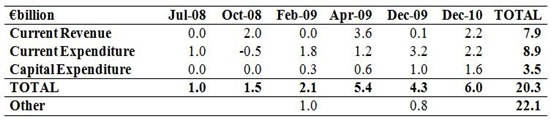
Total Budget Measures

As a result of the half a billion of social welfare measures introduced in October 2008 the total is actually closer to €20 billion rather than the €21 billion figure commonly used.  Of course it would be better if the actual impact of these measures than the incorrect projected impact was used.

Let’s look at what has happened to the three areas:

Budget Outcomes

Compared to 2008 voted expenditure is down €4.8 billion (although nearly 90% of this relates to capital expenditure).  Over the same period current revenue is down almost €7.4 billion.  Although there are other elements to the budget not included here (non-tax revenue, non-voted expenditure) it is hardly surprising the deficit is higher now than it was in 2008, though it has been falling since 2009 (excluding the bank payments).

Capital expenditure has fallen €4.3 billion over the period even though €3.5 billion of cuts are in the austerity total.  The gap is explained by the November 2009 €0.8 billion of capital cuts that is not included.  Capital expenditure is bearing the brunt of the cuts so far.  As this is mainly the cancellation of projects that hadn’t even begun the victims of capital cuts are unknown even to themselves.

Almost €9 billion of current expenditure cuts have been announced but gross voted current expenditure is only €0.5 billion lower than it was four years.  There has been substantial shifts within that total.  At an individual level public sector pay has been cut and many social welfare payments have been reduced.  These are real cuts to the individuals and households.  However, at the aggregate level current expenditure is largely where it was four years ago.

Almost €8 billion of revenue raising measures have been introduced over the period, but revenue is actually €7.4 billion less than it was four years ago.  Once reason for this are the large over-estimates of the impact of the measures by as much as 25% in some cases.

How much austerity have we actually endured?  That is not a question that can be answered in a simple analysis such as this.  If it was €20.8 billion then that would be a average of €4,500 for every man, woman and child in the country or an average of €18,000 per family of four.  There have been tax increases and expenditure cuts but nothing on a scale like that.

I would guess that given the woolly nature of some of the current expenditure measures, the huge overestimates of the impact of the revenue measures, and the actual cuts in the capital budget the last three years has been around €12 billion “sucked out of the economy” with nearly 40% of that as a result of capital expenditure cuts.  This is only a guess. It would be useful if the actual figure was produced.

Wednesday, November 9, 2011

The deficit and “the banks”

The Medium Term Fiscal Statement released last Friday projects that the general government deficit in 2012 will be €13.6 billion or 8.6% of GDP.  This is the number we have to reduce to less than 3% of GDP by 2015, which is what measures to be introduced over the next few Budgets will be targeting.

The simple question here is: how much of the €13.6 billion deficit is due to the banks?

So far we have poured about €62.5 billion into AIB, BOI, EBS, PTSB, Anglo and INBS and all of this has been accounted for in the general government deficits of the last three years.  No further payments are planned so there are no direct payments to the banks in the €13.6 billion deficit for 2012.

What about providing this €62.5 billion?  Surely there are huge interest costs associated with providing this money to the banks.

Of this money €17 billion came from the destruction of the savings we had built up in the National Pension Reserve Fund.  This money was not borrowed so there are no interest costs.  There is the loss of income that this money could have earned but this loss has no bearing on the general government balance.

Of the remaining €45.5 billion almost two-thirds is accounted for by the Promissory Notes given to Anglo and INBS in 2010.  This €30.6 billion was included in full in the €49 billion general government deficit in 2010 and due to some complications in their construction there will be no interest paid on these notes in 2012. 

In 2011, a cash payment of €3.1 billion was made on the Promissory Notes.  This will not affect the debt as the €3.1 billion simply changes from being a Promissory Note debt to a cash debt.  There is now around €28 billion of Promissory Notes outstanding but this will have no impact on the €13.6 billion general government deficit for 2012.

That means we are down to the final €18 billion.  This is split between €11 billion paid from the Exchequer and €7 billion taken as part of the EU/IMF programme.  The money from the Exchequer includes €4 billion given to Anglo in 2009 and €3 billion paid into the NPRF in the same year to help fund the initial recapitalisation of AIB and BOI.  It also includes the €3 billion payment made on the Promissory Notes this year.  It is safe to assume that all of this money was borrowed (or at least increased our borrowing by the same total which amounts to the same thing).

The €7 billion from the EU/IMF was used to fund the State’s  €17 billion contribution to the  €24 billion recapitalisation of the banks this year.  The other €7 billion came from haircuts to subordinated bondholders, some minor asset disposals and some private sector investment in BOI.

We will assume that the average interest rate on this €18 billion is around 4.5%.  At this interest rate, borrowings of €18 billion would require an annual interest payment of around €800 million.  This interest cost does form part of the general government balance for 2012.

If we do a simple counterfactual and magic away the €62.5 billion we have pumped into the banks, the projected deficit for 2012 would fall from €13.6 billion to €12.8 billion or 8.0% of GDP.  Eliminating the effect of the bank payments would knock 5% off the deficit; 95% of next year’s deficit is not related to the bank payments.

There are many claims that the expenditure cuts and tax increases are being introduced to “bail out the banks”, “repay bondholders” and the like.  The changes are being introduced to bring about the necessary reduction in the budget deficit.  There may be disagreements about the make-up of the changes but 95% of the problem there are trying to address is not as a result of the money we have handed over to the banks.

Sunday, October 30, 2011

Where is our money?

The recent Maastricht Letter on Ireland’s financial position released by the Department of Finance shows that the government expects to have €24.8 billion of cash in working balances at the end of 2011, up from €18.7 billion at the end of 2010.  The increase is our cash balances is largely the result of frontloading of our borrowing from the EU/IMF package and the reduced cost to the State of this year’s bank recapitalisation programme.

The ESRI have recommended that “significant interest savings could be achieved by reducing the holdings of cash”.  This is on the basis that the interest cost of our debt is greater than the interest gain from our deposits.

So where are we keeping close to €25 billion of cash?  Here are deposits from Irish residents in all banks operating in Ireland.

Irish Resident Deposits in All Banks

Deposits from government in banks operating in Ireland were €2.8 billion in September 2011.  Of this, €2.4 billion was in the covered banks (AIB, BOI, PTSB), while €0.4 billion was in non-covered domestic banks (Ulster Bank etc.).  There were no deposits in other (IFSC) banks.

Deposits from government did rise to over €20 billion from April to June of this year, but that was the money set aside for the recapitalisation of the banks as we discussed here.  Since July, government deposits have returned to less than €3 billion.

So, if we are supposed to have almost €25 billion of cash at the end of the year where (or what) is it?  Do the NTMA have it?  Are they then included in the Financial Institutions or Private Sector deposits in the banks? Is the increase in cash balances of the State giving the false impression that deposits in Irish banks have stabilised?

As suggested by the ESRI it does seem costly to have a debt of €170 billion, while at the same time having  €25 billion in cash.

Saturday, September 24, 2011

“The IMF made me do it”

The above is sure to be a common refrain over the coming months as the government sets about introducing it’s first budget in December.  Over the summer a €100 household charge was announced and when introducing it Minister for the Environment Phil Hogan said:

“I’d prefer not to be introducing any charges but I’m obliged because we have ceded our economic sovereignty as part of the EU/IMF agreement, to bring in a property tax.”

The suggestion is that the charge is only being introduced because of the EU/IMF programme.  This fails to acknowledge that the originator for the idea was the ‘Four Year National Recovery Plan’ published by the Department of Finance on the 24th of November last year under the previous government.  This is lifted directly from the 140-page document.

Site Value Tax

The IMF didn’t come up with a €100 household charge to be imposed from 2012; we did that ourselves.  In fact the greater amount of the IMF programme for Ireland comes from the Four Year Plan that we produced ourselves.  In a press conference when the IMF intervention in Ireland was announced at the end of November, Ajai Chopra said when asked to rate Ireland’s future prospects:

“What we’re doing right now is helping in this process and making it more robust. We’re augmenting it in some places, and we’re providing a backstop in financing. But the key thing that this is […] a program that is largely designed by the Irish authorities, we’re augmenting what they did already, and the thing that has impressed me most in this regard is the sense of common purpose. The thinking ahead and making a contribution to the solution. So, it’s been very impressive what they’ve done.”

In a subsequent interview on December 17th once the details of the IMF programme has been finalised, Chopra said:

“The fiscal adjustment program is based on the government's 4-year program for national recovery. […]  There may be some adjustments to these policies, but our experience is that if the policies are not owned by the country, they tend not to be implemented strongly enough. In sum, we see this a program that is an Irish program that is a national response that is owned by Ireland.”

The Four-Year Plan from the DoF laid out in general the direction of our budgetary policies until the end of 2014.  Apart from the hugely optimistic growth forecasts that were in the plan it was largely endorsed by the IMF.  The €3.6 billion of tax rises and expenditure cuts that is due in the December budget was also proposed before the IMF programme was agreed.

Budget Adjustments

The IMF accepted the €15.8 billion of proposed tax rises and expenditure cuts over the duration of the plan but did not accept that it would bring the annual deficit under 3% by 2014 (or even 2015 for that matter).

The Four-Year Plan provides some specifics of the measures to be introduced.  Although the following table provides cumulative figures it shows the breakdown of the €1.7 billion of current expenditure cuts to be introduced for 2012.

Expenditure Cuts

It was proposed to save €0.4 billion on public service pay, €0.6 billion on social protection expenditure and €0.6 billion on “other expenditures”.  On the tax side the following details were provided.

Tax Increases

There’s Phil Hogan’s ‘Site Value Tax’ and other measures.  We can expect the price of fuel to go up in the first week of December.  Even more detail of the tax increases was provided in this table.

It is likely that the greater majority of the measures to be introduced in December will have had their genesis in the Four-Year Plan.  While this was published prior to any IMF intervention in Ireland, it is now accepted that the IMF were in contact with Ireland well in advance of the announcement of the formal agreement on the 28th of November.  Again, Ajai Chopra provides the details:

“So, over the months, we’ve been in touch, we’ve talked on the phone, we followed the developments, we’ve tried to understand the various steps that the authorities have taken. And then last week, as you know, after the Eurogroup meeting in Brussels, a small team was invited to come here for short, technical discussions. So, following the technical discussions, the authorities decided they had the basis and the need to request us to (inaudible) together with them a package of policy measures that we could support with our financing.”

The IMF had be “in touch” for months prior to the end of November and may have had some input into the design of the Four-Year Plan, but that document was published in the absence of any formal agreement with the IMF and is primarily what we agreed to do ourselves. 

Claiming that “the IMF made me do it” may make for a catchy political sound-bite but we need to face the reality of the mess we are in and accept to responsibility to solve it.  Creating public animosity with the only institutions willing to lend to us by trying to blame them for the tax rises and expenditure cuts to be introduced is not a useful approach.

Thursday, January 6, 2011

Austerity?

We have now had three years of so-called austerity budgets in Ireland that have focussed largely on expenditure cuts.  So how much has expenditure being cut by?  Lets start with gross expenditure by central government.

Gross Expenditure

At first glance it would appear as if the austerity measures are beginning to bite.  After showing a continual rise to 2009, gross central government expenditure fell from €75.3 billion in 2009 to €69.1 billion in 2010.  However let’s break this down by Voted and Non-Voted expenditure.  Voted expenditure is essentially the money allocated to government departments and offices.  Non-voted expenditure is money that is spent under specific legislation and does not require a separate ‘vote’.

Voted and Non-Voted Gross Expenditure

Since 2008 the increase in voted expenditure has moderated and actually decreased slightly in 2010.  However, most of the decrease in gross expenditure that occurred in 2010 is due to non-voted expenditure.  So called ‘budgetary cuts’ on voted expenditure have had little effect so far in tempering expenditure, with any reduction seen mainly in voted capital expenditure as shown in the next graph.

Voted Current and Capital Expenditure

In fact, if we look at breakdown of total expenditure into current and capital expenditure we see that all of the decrease can be attributed to capital expenditure.  There has been no year when day-to-day or current expenditure has fallen.  None.

Current and Capital Gross Expenditure

When looking at non-voted expenditure it is clear there has been no actual cuts in expenditure.  It is the result of some once-off events in non-voted capital expenditure.

Non-Voted Current and Capital Expenditure

Non-voted current expenditure (mainly interest payments on the National Debt) has been increasing since 2008.  The apparent reduction in non-voted expenditure seen in 2010, is simply due to the once-off increase in non-voted capital expenditure that occurred in 2009.  In 2009 there was €4 billion transferred to Anglo Irish Bank and €3 billion paid to the NPRF to fund the recapitalisations of AIB and BOI.  These payments did not occur in 2010 (and most bank recapitalisations since have been off-balance sheet).

On the current side there has been some reduction in voted current expenditure but this has been more than offset by the increase in interest payments that is pushing up non-voted current expenditure.  Any ‘savings’ being made on current expenditure are more than offset by expenditure increases elsewhere.

Voted and Non-Voted Current Expenditure

The one area where there has been actual reductions is in capital expenditure.  We saw above why non-voted capital expenditure spiked in 2009 and fell sharply in 2010.  Voted (or departmental) capital expenditure has been cut sharply since 2008 and in two years has been reduced from €9.0 billion to €6.4 billion.

Voted and Non-Voted Capital Expenditure

Cutting, or just hiding, capital expenditure is the ‘low-lying fruit’ of an austerity package.  It does not offer sufficient long-term reductions if order is to be restored to the public finances.  Closing a €19 billion budget deficit requires expenditure cuts and tax increases.  Thus far we have grasped neither nettle properly.

Delaying capital projects like road improvements, new railways, metros and other public construction projects does not ‘save’ money as most of these are projects will have to undertaken at some point in the future anyway.  A properly implemented austerity programme has to look to cut current voted expenditure.  The main elements of this expenditure are transfer payments, public sector pay and pensions, and expenditure on goods and services.  The 2010 figures suggest we have seen little austerity so far and it is too early to forecast the impact of the changes announced in Budget 2011.

The budget deficit remains (and is actually getting bigger!).  Is there anyone who will grasp the painful nettle?

Understanding the Public Finances is hard

The Irish system of Public Finance is extremely difficult to get a complete handle on.  Here is a 382-page ‘outline’ that explains it all!

The degree of complexity can be seen from the following sentence from the Minster’s press release that was issued with the 2010 Exchequer Accounts yesterday.

While day-to-day spending was marginally ahead of target in the year, this is due to a shortfall in Departmental receipts rather than overruns in spending.

Come again? Spending is up because receipts are down. My head hurts.

Tuesday, December 14, 2010

Ernst and Glum

Ernst and Young today released a winter forecast of the eurozone economies.  Most of the interest has focussed on their pessimistic forecasts for growth in the Irish economy.  The full report can be read here with the sub-section on Ireland available here.  This is key forecast table extracted from page two of the second linked document.  Click to enlarge.

Ernst and Young Forecasts

Although we are not told we must assume that the growth rates given here are real growth rates.  If we compare these estimates to the current Department of Finance Forecasts we see the gap that exists.

Forecast Comparison

Over the period 2011 to 2014 the DoF predict an average annual real GDP growth rate of 2.7% and with a forecast annual inflation rate of 1.3%, the National Recovery Plan is based around a 2014 nominal GDP level of €183.5 billion.

In stark contrast E&Y have an average annual growth rate of only 0.8% over the same period.  With an average expected inflation rate of 0.0% over the period this implies that E&Y’s forecast of nominal GDP in 2014 is €162.2 billion. 

It is worth noting the nominal GDP in 2007 was €189.4 billion in 2007.  And that this time last year the DoF was forecasting that nominal GDP in 2014 would be €204.8 billion!  Here are the three forecasts.

GDP Forecasts

The importance of nominal GDP is that it is used as the denominator in the debt/GDP ratios that are being imposed on us.  To achieve the 3% budget deficit target by 2014 the original DoF’s figures would have allowed a budget deficit of €6.2 billion.  The revised DoF figures would bring this target down to €5.5 billion, with E&Y’s forecasts only allowing a budget deficit of €4.8 billion.

This might not seem like much of a change but based on E&Y’s forecasts this has to be a achieved on significantly less tax revenue (due to less economic activity) and increased social welfare expenditure (due to more unemployment).  In this environment €15 billion of adjustments may seem like a walk in the park. 

Based on E&Y’s projections it is likely we would need budgetary adjustments of about €25 billion.  So we would need three more Budget’s equivalent to last week’s €6 billion adjustment and the low lying fruit on capital expenditure has already been truly harvested.  Some tough decisions would lie ahead.

Of course, it is likely that E&Y’s forecasts will be wrong. All forecasts are wrong as they have as little idea as we do what the Irish economy will look like in four year’s time.  Like the rest of us they are guessing but they sure have changed their tune.

E&Y produce this eurozone forecast every quarter.  Their autumn report was published on the 30 September last (just 11 weeks ago) and can be read here.  Their table of forecasts on the Irish economy is on page 2.

EY Autumn

This was positively bullish compared to what they’re now saying.  Average GDP growth over the four year’s 2011 to 2014 was forecast to be 3.4%.  This is well ahead of the D0F forecasts released a few weeks later and used in the National Recovery Plan which they now describe as “overly optimistic”! 

They had an average inflation rate forecast of 1.9% for the period, again ahead of the DoF forecasts published a few weeks later, and an average unemployment rate of 11.0% which has now jumped to 15.0%.

In September they provided the following relatively positive conclusion:

Despite the difficulties the Irish economy is still facing in 2010, the outlook for a return to relatively strong rates of GDP growth forecast over the medium term, well above the growth expectations for Greece and Portugal, are still maintained. This is premised on Ireland’s core economic and competitiveness fundamentals and the fiscal measures already in place. Although additional new fiscal measures will be required for 2011 in the December budget.

Now the tune is

The main drag on Irish GDP growth in the next two years will come from domestic demand. Beside the direct negative impact of the fiscal measures, growth will be dampened by a range of related factors that include a large out-migration flow of people (and their skills and spending) and a likely rise in retail interest rates that will impact on consumer spending and housing repossessions. Meanwhile, the large excess supply of housing that may take years to clear will be a significant drag on residential investment. Against
this backdrop, the prospects for business investment are also bleak.

As such, we do not expect the domestic economy to recover until a number of years into the fiscal adjustment cycle, and until after the banking system is restored to health and the housing market returns to some degree of normality.

They have downgraded their growth forecasts because of fiscal measures, outward migration, rising retail interest rates, excess supply of housing and problems in restoring the banking system to health.  Did they not know about these when they made their Autumn forecasts back in September?

Although there has been a huge amount of activity on the economic front in the past two months, the real economy has not gotten any worse.  What we have actually seen is a realisation of how grave the problems the Irish economy face actually are.  This realisation is a good thing.  The economy itself has not suddenly deteriorated to the degree suggested by the E&Y forecasts.  It seems they are buying into the mantra “if you are going to forecast, forecast often”.

Wednesday, December 8, 2010

Social Welfare Expenditure

Following a recent theme here’s another misperception from RTE News last Friday in a report on the release of the White Paper. 

RTE News Social Welfare

The issue is the true nature of the cost of our social welfare system.  In the report David Murphy stated that social welfare expenditure would rise from €13.2 billion in 2010 to €14.2 billion in 2011 (if no changes were introduced in the Budget).  This is partially true.

The White Paper details expenditure by department and the above figure is the estimate of expenditure by the Department of Social Protection in 2010.  It is broken down as follows.

Department of Social Protection

Relative to our banking crisis this would suggest that, although growing, our expenditure on social welfare should be manageable. It seems a relatively light burden for an economy with an expected GDP this year of around €157 billion.  Here is how the €11.2 billion of welfare payments are distributed.

Social Welfare Payments

It is fairy clear that this is not the full list of social welfare payments.  The remainder come from the Social Insurance Fund (SIF).  This fund received a €1.55 billion payment from the Department this year.  However most of the funds receipts come from PRSI contributions.  These were estimated to contribution just over €7 billion to the fund in 2010. 

These do not form part of the Exchequer Accounts as they are paid directly to the SIF so we do not get monthly information on them.  Overall details of the SIF are also difficult to source.  Anyway with €7 billion from PRSI and €1.55 billion from the Department of Social Protection this represents a substantial sum of money.  Here are the payments made from the SIF this year.

SIF Payments

It is only by adding the expenditure on social welfare payments by the Department of Social Protection (€11.2 billion) and the Social Insurance Fund (€9.3 billion) that we get a true measure of total social welfare expenditure.  This is €20.5 billion in 2010.

This is not the full extent as cash transfer provided by the government.  Schemes run by other Departments brought total expenditure on direct transfer programmes to over €26 billion.  This is now a sizable burden for an economy with a GDP of €157 billion (17%) and particularly one with a GNP of €130 billion (20%).

A recent study by TASC shows that our expenditure on Social Protection as a percentage of GDP is now above the EU15 average.  One consequence of the economic crisis has been the complete erosion of the surplus in the Social Insurance Fund.  At the end of 2008 the SIF has a surplus of €3.4 billion.  This surplus was managed by the NTMA and the investment income generated was available to meet social welfare payments.  The NTMA’s annual report for 2009 contained the following section on page 38.

Social Insurance Fund
The income of the Social Insurance Fund derives mainly from Pay-Related Social Insurance (PRSI) contributions by employees, employers and self-employed persons. Payments from the Fund are made in respect of items such as State Pensions, Illness Benefit and Jobseekers Benefit. Since July 2001 the NTMA has managed the accumulated surplus of the Fund, with performance measured against a benchmark agreed with the Minister for Finance.

During 2009 the NTMA transferred €2.9 billion from the Fund back to the Department of Social and Family Affairs, bringing the total under management at the end of the year to € 157 million. The balance of the Fund was transferred back to the Department by the end of April 2010.

The Social Insurance Fund is now empty! It is not just the National Pension Reserve Fund that has been wiped out.

The SIF needed over €1.5 billion from the Department of Social Protection in 2010 just to meet its requirements.  Some changes to PRSI in Tuesday’s Budget will generate some additional revenue (c. €220 million) but it is likely the fund will need to subsidised for the foreseeable future.

Monday, December 6, 2010

Government Expenditure

Here is central, local and total government expenditure in Ireland in 2009.

Total Government Expenditure

It should be noted that local government is part-funded by a grant from central government.  In 2009 this totalled €6,737 million so central government expenditure is actually €69,163 million but to avoid double counting this transfer is excluded from the above table and the money is counted as local government expenditure.

With GDP measured at €159.6 billion in 2009, total government expenditure equates to 47.1% of GDP.  The equivalent GNP figures are €131.2 billion and a staggering 57.3%.  Is there a higher figure in any country?

We just saw that government revenue in 2009 was somewhere around €56.4 billion. A simple subtraction shows us that there was a deficit of around €19 billion in 2009.  This figure is in the public domain.  The process of getting there is, unfortunately, less widespread.

I do not put much value in the division of government expenditure by Department or Vote.  These are not really comparable and are subject to the transfer of functions and agencies between votes.  The CSO data above tells us what the money was used for, the following table of data from the OECD shows us the functions that year’s €76.4 billion of expenditure was used on.

Expenditure Functions

Wednesday, November 17, 2010

Crisis? What crisis?

Minute by minute updates here

10.20am: Brian Lenihan is late, again, for this morning's EU finance minister's meeting in Brussels, Elena Moya tells us. The meeting was due to start at 9.30am GMT.

Tuesday, November 16, 2010

Budget deficits and all that

Here is the unedited version of an article printed in tonight’s Evening Echo.

In 2009 total expenditure by the all the sectors of Irish government was €72 billion. At the same time total receipts of the Irish government were €53 billion. This represents a gap or fiscal deficit of €19 billion. Unlike the costs of our banking collapse, which we hope are once-off, the huge gap in our public finances will continue year after year unless something is done to address it.

The most pessimistic estimates of the total cost of the bank bailout are for a debt of approximately €70 billion to be assumed by the State. However, if left unchecked, the annual deficit in the State’s own finances would match this amount in less than four years and would quickly run ahead of it. To fund this deficit each we year we have to borrow money from international bond markets, and it is clear that such investors now have growing doubts about our ability to repay this money.

There are two ways which the deficit can be closed: increase revenue or reduce expenditure. Although much of the focus has been on expenditure cuts, the deficit has emerged largely because of a collapse in tax revenue. In 2007, tax receipts for the Exchequer were over €47 billion. This year they will struggle to raise €31 billion. We can attribute the main portion of the deficit to the €16 billion drop in tax revenue, which is largely the result of the evaporation of taxes associated with the now departed construction and property bubble.

So how will we close the gap? It is clear that up to a few weeks ago, the Department of Finance had pinned most of our hopes on increased tax revenue which would be generated by a growing economy that had “turned the corner”. We have a €19 billion budget deficit but the plan to address this presented last December suggested that €7.5 billion in budget ‘adjustments’ would be sufficient to close the gap. The remaining €11.5 billion of the deficit would be covered by the buoyant tax revenue provided when our economy returned to the stellar performance of a few years ago. Well that was the plan anyway.

A few weeks ago the finance spokespeople of main opposition parties trooped into the Department of Finance building on Merrion Street. As the day progressed Joan Burton, Arthur Morgan and Michael Noonan emerged ashen-faced and they were the ones to inform us that the ‘head-in-the-sand’ approach did not have much chance of success. It was Michael Noonan who said that “the adjustment required in the Government's four year budgetary plan will be 'significantly higher' than the €7.5 billion figure previously mentioned”.

Why it took so long for this reality to be grasped by all sides of Leinster House is hard to fathom. The European Commission reviewed our original budgetary plan and concluded that “the budgetary outcomes could be worse mainly due to the programme's favourable macroeconomic outlook after 2010”. This was published by the Commission back in March. Yet, it took until the end of October for this nettle to be finally grasped over here. We cannot expect to fill a €19 billion gap with €7.5 billion worth of changes.

And so, last week the Department of Finance produced outline information on some of elements of the new four-year plan it hopes to publish before the end of the month. These sketchy details informed us that the proposed adjustment between now and 2014 could be of the order of €16 billion. At first glance this appears to be much closer to reality.

Last December, when introducing his 2010 Budget, with €4 billion of adjustments, to the Dail, Minister for Finance, Brian Lenihan said that:

“A Cheann Comhairle, the worst is over. The international economy has exited recession. Recent indicators suggest that economic activity in this country is turning the corner, and my Department is now expecting a return to positive growth within the next six to nine months.

The effort demanded of every citizen in this Budget is substantial, but it is the last big push of this crisis. Further corrections will be needed in the coming years, but none as big as today’s.”

As we now know, the script of the Minister did not reflect the subsequent reality of the Irish economy. The 2011 Budget to be announced in a few weeks will feature €6 billion of adjustments. This will continue with further adjustments of €3-€4 billion in 2012, €3-3½ billion in 2013 and €2-2½ billion in 2014. The upper limit of this total is €16 billion.

The use of the word “adjustment” is akin to the ploy of misdirection used by an illusionist. We think we know what he’s doing, but out of sight the full effect of the trick is being prepared. Adjustment is just a word to hide the reality. Adjustment means expenditure cuts or tax increases, but using the word adjustment avoids specifics so we have no idea how this €16 billion of hardship will be distributed. At the moment it is just a number on a page.

Another key issue is the speed of this process. The €19 billion gap is evident to everyone but what is not so evident is why it has to be closed by 2014. This is an artificial target and one that has been largely self-imposed. When we produced the ‘pie-in-the-sky’ plan last December we said we would have the deficit down by 2014. The EU has taken this as our commitment and has tied us to it. Commissioner Ollie Rehn was here during the week and it is likely he was given further promises that we would cut the deficit by 2014.

The target we have to reach is a government deficit of less than 3% of Gross Domestic Product by 2014. Whatever the size of the economy is, as measured by GDP, the government have committed to having a deficit of less than 3% of this by 2014. This year we are likely to run a general government deficit of over 12% of GDP which we must reduce to 3% by 2014.

Our target is based on two elements: the size of the deficit and the size of the economy. The four-year plan is aiming for moving goalposts depending how big the deficit is and what happens to the GDP figures. Up to now the hope was that an economy returning to the growth rates of five years ago would help us reach the target by increasing our total GDP.

Last December we were told that the changes required for the 2011 budget would be €3 billion in adjustments. Now that figure is €6 billion and special-interest groups the length and breadth of the country are getting their message out that their funding and services are vital.

Why have we gone from €3 billion to €6 billion and what are we getting for this extra pain? There are three reasons that explain the jump to the €6 billion adjustment: a fall in GDP, a continued widening of the budget deficit, and a more ambitious deficit target for 2011.

The forecasted GDP number for 2011 has fallen because of a downward revision by the Central Statistics Office of prevision GDP figures. Also, projected GDP for 2011 has fallen because the government has announced they are going to cut more. Direct government expenditure on goods and services (on health and education services etc.) and government funded household expenditure (through social welfare benefits and pensions) are a major component of the economy. If these are cut, the size of the economy is reduced and the allowable budget deficit is reduced. We are cutting more because we have announced we are cutting more. This could be a vicious circle. These changes to the GDP numbers have added €1 billion to the adjustment.

Even with the €4 billion adjustment announced in last December‘s Budget the deficit for this year looks like being even larger than last year. This is because compared to last year, tax revenue is lower, social welfare expenditure is higher and the interest costs on our growing national debt are increasing. We’re trying to close the gap at the same time as the gap is getting wider. This has added a further €1 billion to the adjustment. It is like pouring water into a bucket with a hole in it.

The final reason we have moved to a €6 billion adjustment is the apparent wish to have ourselves viewed as gluttons for punishment. Last year, when we announced the plan to get to a 3% budget deficit by 2014 we said that we would get it down to 10% for 2011, from the 12% this year as an intermediate step on the road to reaching the 3% target. With the economy contracting and the public finances continuing to deteriorate, the Department of Finance has said that we should heap more pain onto the economy by reducing the original target. €1 billion has been added to the adjustment just for the hell of it.

All in all, we will see very little benefit from increasing the budgetary pain from €3 billion to €6 billion. In terms of the EU target we will move from a projected deficit of 10% of GDP for 2011 to a deficit of 9.3% of GDP. We’re going nowhere and it’s like pushing a car with all your might while someone has left the handbrake on.

The government is focusing much of its budgetary efforts on the expenditure cuts and tax increases that it is hoped will meet the 3% target by 2014. We will not meet this target and nor should we be too concerned about this. Yes, the budget deficit has to be addressed, but dancing to a tune called by someone else is not what is required. It is clear that changes have to be made to our public services and our tax system, but they should be done to satisfy the needs of Irish people and not to satisfy an accounting ratio.

We have to decide what is best for Ireland. We have the chance to completely overhaul our public services and tax system but because we are so focussed on an artificial goal we are failing to see the wood from the trees. Making changes at the margin can only offer a temporary solution.

We must decide the kind of public sector and social welfare system we want to have in this country. Do we want a public sector that provides as many services and supports to as many people as possible? If so, we will have to design a tax system that will raise the funds to finance these services. Or do we want to maintain the view of Ireland as a ‘low-tax economy’? If so, we must realise that we will not have the money to provide everything we may wish from our public services. At present we have chosen the impossible. We want the high-cost public services but we cannot pay for them with our current tax base.

Our long-term plan for closing the budget deficit should be based on the type of Ireland we want to see in ten years time. Now is the time to be making these decisions and not fighting over percentage points.

Wednesday, November 10, 2010

The real story

Our previous post looked at changes to DoF nominal GDP projections.  There are none.  What about our GDP in real terms?  In nominal terms it appears that the DoF expect the GDP figure to be no different than it was before, but what about the price effects that will determine the real changes behind these nominal figures?

We can compare the Department’s HICP predictions to the end of 2014 made in December 2009 to those produced last week.

DoF Inflation Predictions

The Department is predicting less inflation (or more deflation) for every year up to 2014.  This is particularly true for 2010 to 2012 with lower inflation of between 0.25% to 0.70% forecast.  For 2013 and 2014 the Department’s forecasts are largely unchanged and are probably influenced by the units the Department chooses to present their forecasts in.

If the Department expects prices to fall faster in 2010 and rise slower in 2011 and 2012, the only way they can meet their nominal GDP projections if they are expecting real GDP to rise by a greater amount than they thought last year.  There must be a greater increase in activity to offset the effect of lower increase in prices.

To see this in practice we will work through the numbers for 2011.  Last December’s SPU has a real growth rate prediction of 3.3% for 2011.  Last week’s EBO gives a predicted real growth rate of 1.75% for 2011.  Surely this is a reduction and is in line with all observer expectations.

The EBO gives 2010 nominal GDP at €157.3 billion.  The real GDP growth rate of 1.75% for 2011 would give a real GDP in 2011 of €160.05 billion at 2010 prices.  The EBO gives a nominal GDP figure for 2011 of €161.2 billion.  This increase in nominal GDP over real GDP is line with the 0.75% inflation expectation.

But we are not comparing like for like.  The 3.3% predicted real growth rate from last December was based on a €3 billion adjustment.  The 1.75% predicted real growth from last week is based on a €6 billion adjustment.  If we again use a fiscal multiplier of 1.0 for the first year and zero thereafter to allow us to simply add back this extra €3 billion that the government is going to cut from the economy, we get a revised real GDP figure of €160.05 billion plus €3 billion equal to €163.05 billion.

Without the extra adjustment the increase in real GDP is predicted to be from €157.3 billion in 2010 to €163.05 billion in 2011.  This is equivalent to a growth rate of 3.66%.

Last December there was a predicted real growth rate for 2011 of 3.3%.  Excluding the effect of the additional adjustment the current predicted real growth rate for 2011 is 3.66%.  We’re not reducing our GDP growth prediction for 2011– we’re increasing it!

If we carry through the same analysis for the years 2012 to 2014 we get the following results.Real GDP Growth Forecasts

We are pinning our hopes to higher growth rates in 2010 and 2011, a largely unchanged growth rate for 2012 and 2013, with the only notable decrease in 2014.  So much for moving away from a “favourable macroeconomic outlook”. 

And this is only achieved with very benign assumptions about the impact of the additional fiscal adjustment on the growth rate.  A more thorough consideration of this effect would probably reveal that the predicted real growth rates for all years have increased.

Did Ollie Rehn really buy into this?

 
Unsecured Loans Proudly Powered by Blogger