Friday, May 10, 2013

Migration flows in both directions

Migration estimates from the CSO have been getting a lot of attention this week.  This is perhaps surprising given that they were published more than seven months ago.  The coverage includes headlines like these from the BBC and RTE.

Both of these headlines are wrong and for different reasons.  The 300,000 figure is correct but it does not relate just to Irish people and was not part of the report issued by the National Youth Council of Ireland yesterday.  It is not clear that any of those reporting on the report have actually read it. 

The report is not an estimate of emigration as indicated by the RTE headline.  In fact, the 300,000 figure that has attracted such attention gets a single passing reference in the report (last paragraph of page 13). 

The key contributions of the report are the results of an opinion poll with a 1,000 respondents in Ireland carried out by Red C in October 2012 and a summary of the feedback from 90-minute focus groups of between 7 and 9 Irish emigrants in each of London and Toronto. 

The BBC headline is incorrect because it overstates the number of Irish emigrants over the past four rears by a factor of more than two.  Here is a summary of the migration estimates from the CSO, where the annual data are to the end of April in each year.

Migration by Nationality

The CSO do estimate that 308,900 people have emigrated from Ireland in the past four years but of these 136,600, or 44% were Irish nationals.  On the other side the CSO estimate that 221,500 have immigrated to Ireland over the same time meaning net migration from an outflow of 87,400 over the four years.  For Irish nationals, net migration was an outflow of 55,500 over the four years.

The bad situation for Irish nationals is deteriorating, with almost half of the net outward migration of Irish nationals occurring in the 12 months to April 2012.  This is the opposite pattern for the other large component of the net migration figure, those from the EU accession states in the EU15 to EU27 countries.  For people from these countries, net outward migration has slowed with 70% of the net outflow shown above happening in the first two years, 2009 and 2010.  A table with a breakdown of the data by nationality and year is below the fold.

Migration Flows by Year

Thursday, May 9, 2013

Misinterpreting youth unemployment rates

Unemployment rates in the EU27 and EA17 have rightfully being front and centre.  They are unacceptably high.  One sub-category that gets considerable attention is the “Youth Unemployment Rate” for those aged 16 to 24 but it is also one that is subject to significant misinterpretation.  Here is President Higgins at a conference in Trinity College back in January as reported by The Irish Times:

“As President of a country that is a member of the European Union I am so conscious of the discourse that concentrates entirely on the security of the currency, but is happy to leave aside the question of an enormous wedge of the population that are unemployed – 55 per cent of people between 18 and 24 in some countries.”

Some youth unemployment rates are as high as 55% but that does not mean that 55% of people in this group are unemployed.  Unemployment rates are calculated as a percentage of the labour force; not the total population.

Here are the youth unemployment rates in the EU at the end of 2012.

Youth Unemployment Rate

At 27%, Ireland is among the worst performers and the over-50% rates of Spain and Greece are clearly evident.

There are 5.6 million people in the EU27 aged between 16 and 24 who are unemployed leading to the youth unemployment rate of 23%.  Per comments like those from President Higgins this would be interpreted as meaning that almost 1-in-4 people in this age group are unemployed.  Not so. There are 56.7 million people aged between 16 and 24 in the EU.

The youth unemployment rate as a percentage of the total number of people in the age group is 10%.  This is unacceptably high but a rate of 1-in-10 is significantly different to a rate of 1-in-4.  The reason for the difference, of course, is that a huge proportion of young people are not in the labour force – they are in education or training.  In Ireland the proportion of people aged between 16 and 24 who are unemployed is 11%, compared to the unemployment rate of 27%..

Here is a chart that gives the number of 16 to 24 years old who are unemployed as a percentage of the labour force and as a percentage of the population.

Youth Unemployment Rate

It is still an ugly picture with rates for the population measure ranging from 3.8% in Germany to 20.5% in Spain.

Core inflation edges up

Although the overall inflation rate from the April Consumer Price Index was unchanged at 0.5% what we have termed the ‘core’ rate of inflation edged up.  The measure excludes mortgage interest (down 6.8% in the year) and energy products (almost unchanged in the year with a drop of 0.1%).  This represent about 15% of the overall index.  The overall and ‘core’ inflation rates for the past few years have been like this.

Core Inflation April 2013

Although it increased in April, at 0.9% the core rate of inflation is still below the levels it was at for most of the past year.  Finally here is an interesting chart from Danske Bank which compares the Irish Harmonised Index of Consumer Prices (HICP) inflation rate, which also excludes mortgage interest, with the euro area average.

Danske Inflation Chart

Is the household sector balance sheet improving?

The words finally and slowly could be added to the above question but the Q4 2012 Quarterly Financial Accounts released yesterday by the Central Bank suggest that some minor improvements are occurring, though the needle is far from leaving the red zone.  The CB’s data is here and the information release on the Q4 update is here.

On the liability side, household sector loans have been declining since late 2008.

Household Loans

Long-term loans are those that had an original maturity of more than one year.  Since 2008 short-term loans (less than one year maturity or repayable on demand) have declined from €13.4 billion to €6.4 billion.  The €174 billion of outstanding loan liabilities of the household sector is roughly comprised of:

  • Owner-occupied mortgages: €111 billion
  • Buy-to-let mortgages: €31 billion
  • Credit card debt: €3 billion
  • Credit union loans: €6 billion
  • Other consumer debt: €23 billion

These are gross figures and we know that a lot of loans issued during the credit boom will never be repaid in full and dealing with those has been unacceptably slow.  Yesterday’s release indicated that there was €0.4 billion of household loans written off in Q4 2012.   It is not clear where this happened but the sub-prime mortgage lenders which have combusted are a likely candidate.  By September 2011, nearly 60% of the €2 billion of mortgages issued by the sub-prime lenders were already in 90 day arrears.

The primary reason for the reduction in the nominal amount of loan liabilities of the household sector is net loan repayments: repayments on existing loans exceed drawdowns of new loans.  Although total loans have fallen by €30 billion over the past few years this has not translated into an improvement in the usual measures of debt sustainability.  This is because of the drop in household disposable income that occurred over the same period.

Here is the disposable income of the household sector as measured in the CSO’s Institutional Sector Accounts.   This reflects the household sector as a whole and not simply those carrying the loans shown above.  The income drops in that subset could have been larger or smaller than those shown below.

Household Disposable Income

Anyway, combining the loan and income data gives the following.
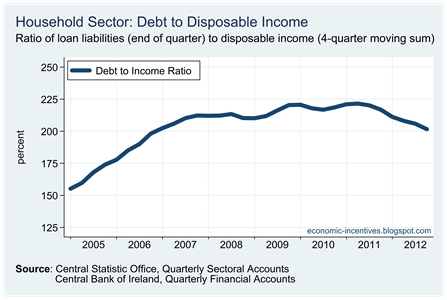
Household Debt to Income Ratio

Although, loan liabilities in nominal terms began to fall in late 2008 the debt-to-income ratio continued to rise through 2009 and 2010 and peaked at 222% in the second quarter of 2011.  It has since fallen for six quarters in a row and stood at 202% at the end of 2012.  This is a welcome fall of 20 percentage points but the ratio is still very elevated and has only returned to mid-2006 levels.

The reduction has been helped by the increase in gross disposable income which is measured as:

Self-employed/mixed income + wages + net property income – taxes and social and social contributions + social benefits and other transfers

Here are the figures for the household sector since 2008.

Household Disposable Income 2012

Household income in 2012 was boosted by an almost €2 billion increase in self-employed income, a slight rise in nominal wages while net property income benefitted from the ECB interest rate reductions in late 2011 which reduced the interest paid on loans by more than the interest received on deposits (after the FISIM – Financial Intermediary Services Indirectly Measured – adjustment was made).  The various components of Other transfers (non-life insurance, fines and penalties, inter-household transfers, lotteries etc/) can be read about here (click red right arrow on page to progress).

As well as an increase in the flow of (nominal) income, the stock of wealth in the household sector is also increase.  We have seen the reduction in loans which was the key contributor to the €8 billion reduction in financial liabilities over the year.  Financial assets increased slightly over the year.

Household Financial Assets

Much of the increase in 2012 is down to the net equity of households in life insurance reserves which increased from €62 billion to €71 billion over the year.  As well as that household deposits have begun to edge up, rising by €3 billion over the year. 

Household Deposits

The Central Bank estimate that the value of housing assets held by the household sector continued to fall in the early part of 2012 but was largely static since then.  Adding the figures for financial assets and housing assets and subtracting financial liabilities gives the following picture for net household wealth.

Household Net Worth

After 17 consecutive quarters of decline, net worth of the household sector has risen in the past two.  Of course, the increase is derisible compared to the collapse which preceded it but it is a move in the right direction.  And it should go without saying that this aggregate analysis of the household sector offers no insight into the huge disparities that exist between the ongoing experiences of individual households.

Friday, May 3, 2013

Household Social Contributions

Following a comment to an earlier post here is a quick table of actual social contributions made by households in the EU.  The data is for 2011 and some countries have missing values. 

This table excludes imputed social contributions which are largely pension contributions made by public sector workers to the government sector.  Public sector workers have deductions described as pension contributions (Irish public sector workers also have a “pension” levy) but these deductions are not used to fund pension benefits; the money is used to fund other current expenditures by government (or alternatively it can be viewed as not being given to the public sector workers in the first place).  Government pensions tend to be funded from current revenue rather than the accumulated savings of pension contributions. 

Anyway here are the actual social contributions made by the household sector across the EU.  The relevance is that the actual contributions made to government are included in Eurostat’s calculation of an implicit tax on labour whereas as contributions made to the private sector are not.  Click to enlarge.

Actual Social Contributions

Here is the proportion of household social contributions paid to the government sector in a selected group of countries.

  • Greece    96.0%
  • Spain    95.7%
  • Austria    94.9%
  • Finland    93.6%
  • France    90.5%
  • Italy    89.9%
  • Belgium    84.4%
  • Germany 82.8%
  • Netherlands 63.5%
  • Ireland    62.9%
  • Sweden    56.9%
  • United Kingdom 53.9%
  • Denmark    12.6%

Thursday, May 2, 2013

Implicit Tax Rate on Labour

Much of the recent emphasis has been on the corporate income tax, but the Eurostat Tax Statistics Annual provides insight on all taxes.  Here are Eurostat’s implicit tax rates on labour for each of the 27 member states in 2011.

PIT ITR

Ireland is right down towards the bottom with the main reason for the difference being the lower rates of social insurance contributions and, in particular, employer social insurance contributions.   The chart offers nothing on the pattern of the implicit tax rate on labour at different wage levels.  Ireland has a very progressive system of Income Tax with low rates (in relative EU terms) on low/middle incomes and average rates and possibly even above average rates (in relative EU terms) on high incomes.  Ireland has low social insurance contributions, employee and especially employer, at all income levels.

The implicit tax rate on labour is explained on page 284 and is summarised in the following box and definition:

Implicit Tax Rate on Labour

The ITR on employed labour is defined as the sum of all direct and indirect taxes and employees' and employers' social contributions levied on employed labour income divided by the total compensation of employees working in the economic territory (see Box F.2).

The ITR on labour is calculated for employed labour only (so excluding the tax burden falling on social transfers, including pensions). Direct taxes are defined as the revenue from personal income tax that can be allocated to labour income. Indirect taxes on labour income, currently applied in some Member States, are taxes such as payroll taxes paid by the employer.

The compensation of employees is defined as total remuneration, in cash or in kind, payable by an employer to an employee in return for work done. It consists of gross wages (in cash or in kind) and thus also the amount paid as social insurance contributions and wage withholding tax. In addition, employers' contributions to social security (including imputed social contributions) as well as to private pensions and related schemes are included. Personal income taxes and social security contributions paid by EU civil servants to the EU Institutions are excluded. Compensation of employees is thus a broad measure of the gross economic income from employment before any charges are withheld.

Wednesday, May 1, 2013

Reasonably strong retail sales?

At the time of Budget 2013 back in December the Department of Finance projections indicated that the Consumption Expenditure component of GDP would decline by 0.5% in real terms in 2013.  The Department has revised their projections in the 2013 Stability Programme Update published yesterday.

On Consumption the SPU (page 12) says :

Consumer spending held up relatively well at the end of last year, and core retail sales have been reasonably strong in the early part of this year. Slightly better-than-assumed labour market conditions and the likelihood of lower-than-anticipated inflation will also support consumption which is now projected to increase by 0.2 per cent.

Have core retail sales been “reasonably strong” to lend support to this revision from –0.5% to +0.2%?  If one looks at the annual changes in the series there does seem to be some support for this.

Annual Change Ex Motor Trade Index

From August 2012 to February 2013 the annual change in both the value and volume of core retail sales was positive, though provisional data indicate that this was reversed in March.  But the series of 12-month changes can obscure what is happening now.  Here are the index values for the series (scaled with January 2010 = 100).

Ex Motor Trades Index

It is clear that the most recent figures are far from cheery.  After been largely flat through 2011 and the start of 2012 core retail sales did show a reasonably strong rise from July to October last year (helped in part by the digital switchover) but have now reversed all of those gains and have shown monthly declines for four of the past five months.  In the first three months of 2013 core retail sales have not been reasonably strong; they have been weak.

The motor trades are excluded from core retail sales but are included in Consumption (c. 4%).  How have they been faring out?

Motor Trades

Down 8% on 2012, though there is the possibility that the new 131/132 license plate system will push more of this year’s sales in the second half of the year.

And finally there is consumption on services.  The is no Retail Sales Index equivalent for services but the CSO have begun producing a Monthly Services Index which looks at all services, rather than just those purchased by consumers.  From that we can extract two series which may be useful here.

  • Accommodation and Food Activities
    • NACE 55 Accommodation
    • NACE 561, 562 Food Services Activities
  • Other Services
    • NACE 68 Real estate activities
    • NACE 92 Gambling and betting activities
    • NACE 93 Sports activities and amusements and recreation activities
    • NACE 95 Repair of computers and personal and household goods
    • NACE 96 Other personal service activities

Services Index

Both are heading in the wrong direction and Other Services are  well below the levels seen at the start of last year, though this didn’t last beyond April.  The volatility also suggests that short-term trends can be quickly reversed.  It should also be noted that these are value or nominal series whereas the discussion up to now as been on volume on real series.  The CSO hope to progress to producing a volume index in the future.  The sample for the services index is also worth noting:

The sample size is approximately 2,100 enterprises. The sample comprises a census of all enterprises with an annual turnover value of more than €20m or enterprises with more than 100 persons engaged. The remainder of the target population is stratified using 2-digit Statistical Classification of Economic Activities in the European Community, i.e. NACE Rev. 2 classifications. Each of these 2-digit NACE sectors are further subdivided into strata based on turnover. A simple random sample is then drawn from each stratum. Retail and Motor Trade figures are taken from the separate Retail Sales Index sample of approximately 1,400 enterprises.

All told, there is little thus far in 2013 to indicate that retail sales have been “reasonably strong”.  Maybe there will be a minor boost from tomorrow’s ECB Governing Council meeting …

 
Unsecured Loans Proudly Powered by Blogger